Gonadal maturity scale of Eastern Pacific bonito Sarda chiliensis chiliensis (Cuvier, 1832)
Keywords:
Sarda chiliensis chiliensis, maturity stages, gonadal development, histologyAbstract
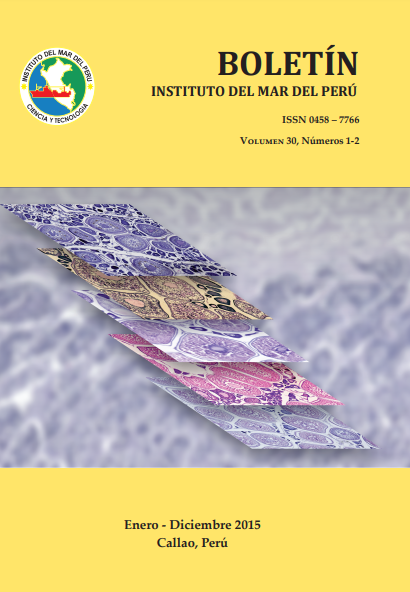
The aim of this study is the elaboration of a Sarda chiliensis chiliensis macroscopic gonadal maturity scale, validated with histological analysis. 591 gonad samples taken from the Pelagic Fishery Monitoring System in 2014 were studied. A gonadal maturity stage was assigned for each individual after microscopic observation of oocyte development in histological sections of each gonad. Six stages of maturity ranging from 0 (virgin) to stage 5 (recovery in females, post expulsion in males) were described. The description of this maturity scale is compared with other studies previously performed, cataloging criteria is discussed and recommendations are given for future monitoring of the fishery.
Downloads
Metrics
References
Barnhart PS.1927. Pelagic fish eggs off La Jolla, California. Scripps Inst. Oceanogr. Tech. Serv. 1(8): 91 – 92.
Buitrón B, Perea A, Mori M, Sánchez J, Roque C. 2011. Protocolo para estudios sobre el proceso reproductivo de peces pelágicos y demersales. Inf. Inst Mar Peru 38(4): 373-383.
Chirinos de Vildoso A. 1960. Estudios sobre la reproducción del bonito Sarda chilensis (C. y V.) en aguas adyacentes a la costa peruana. Minist. Agric. (Perú), Serv. Div. Cient. 14 (2d ed.). 75 pp.
Gerritsen HD, McGrath D. 2006. Variability in the assignment of maturity stages of plaice (Pleuronectes platessa L.) and whiting (Merlangius merlangus L) using macroscopic maturity criteria Fisheries Research. 77: 72 – 77.
Goldberg SR, Mussiett D. 1984. Reproductive cycle of the Pacific Bonito, Sarda chilensis (Scombridae), from Northern Chile. Pacific Science. 38 228–231.
Johansen AC. 1919. On the large spring – spawing sea – herring (Clupea harengus l.) in the north –west European waters. Medd. Fra. Komm. Havunders, Ser. Fiskeri Bind. 5(8): 1-56.
Kjesbu OS, Hunter JR, Witthames PR. 2003. Report of the working group on Modern approaches to assess maturity and fecundity of warm- and cold-water fish and squids. Institute of Marine Research. Fisken og Havet 12: 7-9.
Pauly D, Chirinos de Vildoso AC, Mejía J, Samamé M, Palomares ML. 1987. Population dynamics and estimated anchoveta consumption of bonito (Sarda chiliensis) off Peru, 1953 to 1982, p. 248-267. In: D. Pauly and I. Tsukayama (eds.). The Peruvian anchoveta and its upwelling ecosystem: three decades of changes. ICLARM Studies and Reviews 15.
PRODUCE. 2012. Anuario Estadístico Pesquero y Acuícola. Ministerio de la Producción. 180 pp.
Samamé M. 1993. Algunos aspectos de la biología y pesquería del bonito Sarda chiliensis chiliensis de la costa norte del Perú. Pag. 261 – 272. En: E. Castillo de Marrueda (Ed.) Memoria X CONABIOL, 02 – 07 Agosto 1992. Lima – Perú.
Schaefer MB, Orange C. 1956. Estudios mediante el examen de gónadas del desarrollo sexual y desove del atún aleta amarilla (Neothunnus macropterus) y del barrilete (Katsuwonus pelamis) en tres regiones del Pacífico Oriental. Inter-Amer. Trop. Tuna Comm. Bull. 1(6): 321-349.
Schweigger E. 1947. El litoral peruano. Cia. Administradora del guano. Lima. 414 pp.
Walford LA. 1937. Marine game fishes of the Pacific Coast from Alaska to the Equator. Cont. Santa Bárbara Mus. Nat. Hist. Uni. California Press. 205 pp
Downloads
Published
How to Cite
Issue
Section
License
Copyright (c) 2015 Instituto del Mar del Perú

This work is licensed under a Creative Commons Attribution 4.0 International License.
© Bol Inst Mar Perú. La revista retiene los derechos patrimoniales de los autores con la finalidad de garantizar el acceso abierto de los manuscritos.
Todos los manuscritos publicados en la revista se distribuyen bajo la licencia “Creative Commons Atribución - NoComercial - CompartirIgual 4.0 Internacional” (CC BY-NC-SA 4.0). Implica que autores y lectores pueden de forma gratuita descargar, almacenar, copiar, redistribuir, remezclar, transformar o generar obras derivadas a partir del manuscrito, siempre y cuando mencionen la fuente primaria de publicación y la autoría del manuscrito, así como que se realice sin fines comerciales y se distribuya bajo la misma licencia que el original. Puede consultar desde aquí la versión informativa y el texto legal de la licencia.


