Producción primaria en el ambiente marino en el Pacífico sudeste, Perú, 1960-2000
Palabras clave:
Producción primaria, ambiente marino, afloramiento, costa peruanaResumen
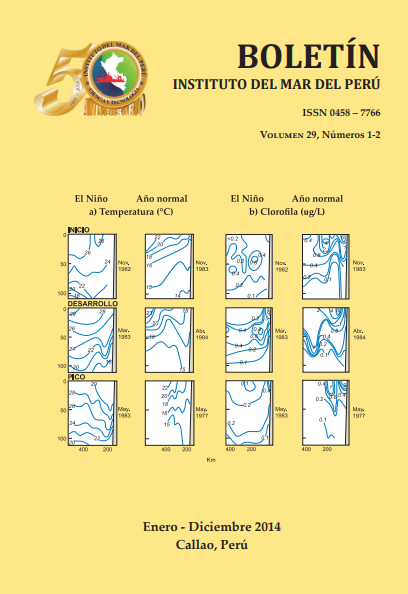
Los resultados de investigación sobre producción primaria dentro del alcance interdisciplinario del ambiente marino frente a la costa peruana incluyen estudios nacionales, extranjeros y de investigación conjunta a través de proyectos internacionales (1960-2000). La circulación en la costa peruana es dominada por una corriente hacia el ecuador en una capa de 20 a 50 m. La estructura de plumas del afloramiento se presenta en cada área y podría ser la clave para el desarrollo de cadenas cortas y productivas: fitoplancton peces clupeidos. La distribución de nutrientes sigue la pluma de temperatura, con altos valores en la costa y bajos lejos de la costa; la clorofila muestra mínimos valores cerca de la costa (10 mn) que se incrementa al alejarse. El crecimiento del fitoplancton en aguas peruanas, varía de 0,5 a 0,8 d/d. En aguas recién afloradas el crecimiento es limitado por falta de “condicionamiento biológico” y de compuestos orgánicos (15°S). Estos tipos de agua pueden estar relacionados con las “aguas azules” de altos nutrientes y pobre fitoplancton con células de pequeño tamaño (clorofila <2 μg/L) y con “aguas marrones” con denso fitoplancton, (clorofila >5 μg/L), mayor diversidad y con células de diámetro >5μ. La media de producción primaria fue 3 gC/m2/d (1960-1985), comparable a la mayoría de estudios en los cuales varía entre 3 y 4 gC/m2/d en la franja costera, el último valor es altamente variable en espacio, siendo más frecuente dentro de 10 km. Valores mayores de 12 gC/m2/d se encontraron en el afloramiento de Chimbote. El Niño, La Niña y fases del ENSO, afectan la producción primaria. Las temperaturas bajas originan cambios en la composición química del fitoplancton y reducen el índice de productividad mgC/mgclor-a/d que también es atribuido a limitaciones de luz.
Descargas
Métricas
Citas
Barber RT. 1967. The distribution of dissolved organic carbon in the Peru Current System of the Pacific Ocean. Ph. D. Thesis, Stanford University, Palo Alto, California, 132 pp.
Barber RT. 1976. Biological Aspects of Coastal Upwelling. In: Book of Abstracts, Joint Oceanography Assembly Edimburgh, Scotland 1976: 13- 24. FAO, Roma, 34 p.
Barber RT, Ryther JH. 1969. Organic chelators factors affecting primary production in the Cromwell Current Upwelling. J. Exp. Mar. Biol. Ecol.3, 191-199.
Barber RT, Smith RL. 1981. Coastal upwelling ecosystems. In: Analysis of Marine Ecosystems, Longhurst AR. (ed.): 31-68. Academic Press, NY.
Barber RT, Chavez FP. 1983. Biological consequences of El Niño. Science, 22: 1203-1210.
Barber RT, Dugdale RC, MacIsaac J, Smith RL. 1971. Variaciones en el crecimiento del fitoplancton asociadas con la procedencia y el condicionamiento del agua aflorada. Inv. Pesq. 35 (1): 171-193.
Blasco D. 1971. Composición y distribución del fitoplancton en la región del afloramiento de las costas peruanas. Inv. Pesq. 35 (1): 61-112.
Blasco D, Estrada M, Jones B. 1980. Relations between the phytoplankton distribution and composition and the hydrography in the upwelling region near Cabo Corbeiro. Deep-Sea Res 27:799–821
Beers JR, Stevenson MR, Eppley RW, Brooks E. 1971. Plankton populations and upwelling of the coast of Peru, June 1969. Fish Bull. Vol. 69(4): 859-876.
Brink K, Van Leer J, Mores C, Stuart D, Stevenson M, Dugdale R, Herburn G. 1981. Physical and Biological Structure and Variability in an Upwelling Center off Peru near 15°S during March 1977. In: Coastal Upwelling, Richards F. (ed.) American Geophysical Union, Washington, D.C: 473-493.
Calienes R, Aquino R. 1986. Carbón orgánico particulado, clorofila y fotosíntesis en el área de afloramiento entre Pimentel y Chimbote (07°-09°S). Bol. Inst. Mar Perú / OEA, Vol. 10 (8): 285-305.
Calienes R, Guillén O, Lostaunau N. 1985. Variabilidad espacio-temporal de clorofila, producción primaria y nutrientes frente a la costa peruana. Bol. Inst. Mar Perú, Vol.10 (1).
Chavez FP. 1989. Size distribution of phytoplankton in the central and eastern Pacific. Global Biogeochemical Cycles 3, 27-35.
Chavez FP. 1995. A comparison of ship and satellite chlorophyll from California and Peru. Journal of Geophysical Research 100, 24855 - 24862.
Chavez FP, Barber RT. 1983. Progression of the 1982-83 El Niño off northern Peru. Trop. Ocean-Atmos. Newsl. Oct. 1983: 26-28.
Chavez FP, Barber RT. 1985. La productividad de las aguas frente a la costa del Perú. CPPS. Bol. ERFEN N° 15: 9-13.
Chavez FP, Barber RT. 1987. An estimate of new production in the equatorial Pacific. Deep- Sea Research, Vol. 34 (7): 1229-1243. J. Pergamon Journals LTd., Great Britain.
Chavez, FP, Barber RT, Sanderson MP. 1989. The potential primary production of the Peruvian upwelling ecosystem: 1953-1984 p 50-63. In. Pauly D, Muck P, Mendo J, Tsukayama I. (eds.). The Peruvian Upwelling Ecosystem: dynamics and interactions. ICLARM Conference Proceedings 18, 438 p. Instituto del Mar del Perú (IMARPE), Callao, Perú; Deutsch Gesellschaft fur Technische Zusammenarbeit (GTZ) GmbH, Eschborn, Federal Republic of Germany and International Center for Living Aquatic Resources Management (ICLARM), Manila, Philippines.
Chirinos de Vildoso A. 1976. Aspectos biológicos del fenómeno El Niño (1972-73). Parte I. Distribución de la fauna. Actas de la Reunión de Trabajo sobre el fenómeno conocido como El Niño. Guayaquil, Ecuador. FAO Informes de Pesca N° 185.
Codispoti LA. 1981a. On nutrient variability and sediments in Upwelling Regions, In: Coastal Upwelling, Suess and Thyede (eds.): 125-145. Plenum Press.
Codispoti LA. 1981b. Temporal nutrient variability in three different upwelling regions, In Coastal Upwelling, Richards F. (ed.), American Geophysical Union, Wash., DC.: 209-220.
Codispoti LA, Christensen JP. 1985. Nitrification, denitrification and nitrous oxide cycling in the eastern tropical South Pacific Ocean. Mar. Chem. 16: 277-300.
Cushing DH. 1958. The effect of grazing in reducing the primary production: A review. Rapp, P. - v. Cons. perm. int. Explor. Mer., 144: 149-153.46
Cushing DH. 1971. Upwelling and the production of the fish. Adv. Mar. Biol. 9: 255-334.
Daugbjerg N, Hansen G, Larsen J, Moestrup O. 2000. Phylogeny of some of the major genera of dinoflagellates based on ultrastructure and partial LSU rDNA sequence data, including the erection of three new genera of unarmoured dinoflagellates. Phycologia 39: 302-317.
Dugdale RC. 1972. Chemical Oceanography and Primary Productivity in Upwelling Region. Geoforum II: 47-61. Dep. of Oceanography, Univ. Was. Seattle, USA. 45 pp.
Dugdale RC, Goering JJ. 1967. Nutrient limitation in the sea. Dynamics, Identification and Significance. Limnol. Oceanogr. 12: 685- 695.
Dugdale RC, Goering JJ. 1970. Nutrient limitation and the path of nitrogen in Peru Current production. In: Anton Bruun Report 4, Texas & M Press, 53-58.
Dugdale RC, Mc Isaac J. 1971. Un modelo representativo de la asimilación de nitrato en la región del afloramiento de Perú. Inv. Pesq. 35 (1): 299-308.
Dugdale RC, Goering JJ, Barber RT, Smith RL, Packard TT. 1977. Denitrification and hydrogen sulfide in the Peru upwelling region during 1976. Deep - Sea Res. 24: 601- 608.
Enfield DB. 1976. Oceanography in the region north of the Equatorial front, physical aspects. FAO Fish Rep. 185: 299-334.
Enfield DB. 2001. Evolution and historical perspective of the 1997-1998 El Niño Southern Oscillation Event. Bull of Marine Science 69 (1): 7-25.
Enfield DB, Smith RL, Huyer A. 1978. A compilation of observations from moored current meters: wind, currents and temperature over the continental shelf and slope off Peru during JOINT II-March- May 1976. Coastal Upwelling Ecosystems Analysis Data Report 52, 343 pp.
Eppley RW. 1972. Temperature and growth in the sea. Fishery Bull., Vol. 70 (4): 1063-1085.
Eppley RW, Strickland JDH. 1968. Kinetics of Marine Phytoplankton Growth. In: Advances in Microbiol. of the Sea, Vol.1, Droop MR, and Ferguson Wood J. (eds.), Academic Press, NY.
Eppley RW, Peterson B. 1979. Particulate organic matter fux and planktonic new production in the deep ocean. Nature 282: 667-680.
Eppley RW, Rogers JN, McCarthy JJ. 1969. Half-saturation constants for uptake of nitrate and ammonium by marine phytoplankton. Limnol. Oceanogr. 14: 912-920.
Fahrback E, Brockman Ch, Lostaunau N, Urquizo W. 1981. The Northern Peruvian Upwelling System during ESACAN Experiment. In: Coastal Upwelling, Richards F. (ed.): 134-145. American Geophysical Union, Wash., DC. USA.
Friederich GE, Codispoti LA. 1981. The effects of mixing and regeneration on the nutrient content of upwelling waters off Peru, In: Coastal Upwelling, Richards F. (ed.) American Geophysical Union. Wash. DC. 221-227.
Guillén O. 1973. Carbon/Chlorophyll relationships in Peruvian Coastal Waters. Oceanography of the South Pacific 1972, comp. R. Fraser New Zealand National Commission for UNESCO, Wellington. 1973.
Guillén O, Izaguirre de Rondán R. 1973. Distribution of chlorophyll-a in the Peru coastal current. Oceanography of the South Pacific, comp. Fraser R. New Zealand National Commission for UNESCO, Wellington 1973.
Guillén O, Calienes R. 1981 a. Biological Productivity and El Niño. I. Resource Management and Environmental Uncertainty, Lessons from Coastal Upwelling Fisheries, Glantz MH, Thompson JD. (eds.): 255-282. WileyInterscience Publication. John Wily & Sons, NY.
Guillén O, Calienes R. 1981b. Upwelling off Chimbote. In: Coastal Upwelling, Richards F. (ed.): 312-326. American Geophysical Union, Wash. DC., USA.
Guillén O, Calienes R, Izaguirre de Rondán R. 1977. Medio ambiente y producción primaria frente al área Pimentel- Chimbote. Bol. Inst. Mar Perú. 3: 107-159.
Harrison WG, Platt T. 1981 Primary production and nutrient fluxes off the northern coast of Peru: A Summary. Bol. Inst. Mar Peru, Vol. Extraordinario / ICANE: 15-21.
Holm-Hansen O, Lorenzen J, Holmes RW, Strickland JDH. 1965. Fluorometric determination of chlorophyll. J. Cons. 30: 3-15.
Jordán R. 1971. Distribution of anchoveta (Engr au lis ringe ns J.) in relation to the environment. Inv. Pesq. 35 (1): 113- 126.
Jordán R. 1985. Los efectos de El Niño 1982-1983 y los mecanismos internacionales para investigación. Bol. Inst. Mar Perú, Vol. Extraordinario/GTZ El Niño, Artzn W, Landa A, Tarazona J. ( eds.): 206-215.
Lorenzen C. 1968. Carbon/chlorophyll relationships in an upwelling area. Limnol. Oceanogr., Vol 13 (1): 202-204.
MacIsaac J J, Dugdale R C. 1972. Interactions of light and inorganic nitrogen in controlling nitrogen uptake in the sea. Deep- Sea Res. 19: 209-232.
Margalef R. 1978a. What is an upwelling ecosystem?. In: Upwelling Ecosystems, Boje R, Tomczak M. (eds.): 12- 14. Springer Verlag, NY.
Margalef R. 1978b. Life-forms of phytoplankton as alternatives in an unstable environment. Oceanologica Acta, 1: 493-509.
Mullin MM. 1969. Production of zooplankton in the ocean: the present status and problems. Oceanogr. Mar. Biol. Annu. Rev., 7, 293–310.
Mullin MM, Sloan PR, Eppley RW. 1966. Relationship between carbon content, cell volume, and area in phytoplankton. Reprinted from Limnology and Oceanography, Vol. 11 (2): 307-311.
Nelson DM, Goering JJ, Boisseau DW. 1981. Consumption and regeneration of Silicic Acid in three coastal upwelling systems. En F. A. Richards [ed.], Coastal Upwelling. Coastal and estuarine Science 1. American Geophysical Union.Washington. p. 242-256.
O´Brien JJ, Busalacchi A, Kindle J. 1981. Ocean models of El Niño. In: Resources Management and Environmental Uncertainty: Lessons from Coastal Upwelling Fisheries, Glantz M, and Thompson D. (eds.), Vol. 11: 159-212. Wiley Interscience
Ochoa N, Rojas de Mendiola B, Gómez O. 1985. Identificación del fenómeno El Niño a través de los organismos fitoplanctónicos. Bol. Inst. Mar Perú, Vol. Extraordinario/GTZ, El Niño, su impacto en la fauna: 23 - 31.
Pennigton JT, Mahoney KL, Kuwahara VS, Kolber DD, Calienes R, Chávez FP. 2006. Primary production in the eastern tropical Pacific: A review. Progress in Oceanography 69 (2006): 285-317.
Platt T, Gallegos CL, Harrison WG. 1981. Photo inhibition of Photosynthesis in natural assemblages of Marine Phytoplankton. Bol. Inst. Mar Perú, Vol. Extraordinario/ ICANE: 102-111.
Redfield AC. 1942. The processes determining the concentration of oxygen, phosphate and others organic derivatives within the depths of the Atlantic Ocean. Papers Phys. Oceanogr. Meteorol. 9 (2): 1-22.
Redfield AC, Keys AB. 1938. The distribution of ammonia in the waters of the Gulf of Maine. Biol. Bull., 74: 83-92.
Redfield A, Ketchum B, Richards F. 1963. The influence of organisms on the composition of sea water. The Sea, Hill MN. (ed.): 26-27, Willey, NY.
Richman JG, Smith SL. 1981. On the possible enhancement of oxygen depletion in the coastal waters of Peru between 6°S and 11°S. Bol. Inst. Mar Perú, Vol. Extraordinario/ ICANE: 22-33.
Rojas de Mendiola B. 1971. Some observations on the feeding of the Peruvian anchoveta Eng rau lis ringe ns J. in two regions of the Peruvian coast. In: Fertility of the Sea, Costlow J. (ed.), Vol. 1: 417-440.
Rojas de Mendiola B. 1981. Seasonal phytoplankton along the Peruvian Coast. In: Coastal Upwelling, Richards F. (ed.): 348-356. American Geophysical Union, Was. DC, USA.
Rojas de Mendiola B, Gómez O, Ochoa N. 1985. Efectos del fenómeno El Niño sobre el fitoplancton. Bol. Inst. Mar Perú. Vol. Extraordinario. 33-40 pp.
Ryther JH. 1963. Geographic variations in productivity, In The Sea, Hill M. (ed.) Vol. 2: 347-380.
Ryther JH. 1969. Photosynthesis and fish production in the sea. Science, 166: 72-76.
Ryther J, Menzel D, Hulburt E, Lorenzen C. Corwin N. 1970. The production and utilization of organic matter in the Peru Coastal Current. A. Bruun Southeastern Pacific Biological Oceanogrophic Program of the National Science Foundation, March 1970: 4.3-4.12.
Smith RL. 1981. A comparison of the structure and variability of the flow field in three coastal upwelling regions: Oregon, Northwest Africa and Peru. In: Coastal Upwelling Richards F. (ed.): 107-118. American Geophysical Union, Wash. DC. USA.
Smith WO, Barber RT. 1979. A carbon budget for the autotrophic ciliate esodinium rubrum. J. Phycol. 15:27-33.
Smith RL, Enfield DB, Hopkins T, Pillsbury R. 1971. La circulación en un sistema de afloramiento: campaña PISCO. Inv. Pesq.35 (1): 9-24.
Sorokin Yu I. 1981. Marine microheterotrophs. In: Longhorst, H. (ed.) Analysis of marine ecosystems. Academic Press, London, p. 293-342.
Sorokin Yu I, Kogeltshatz J. 1979. Analysis of heterotrophic microplankton in an upwelling area. Hydrobiol.66: 195-208.
Steeman Nielsen O. 1952. The use of radio-active (C14) for measuring organic production in the sea. J. Cons. perm. int. Explor. Mer. 18:117-140.
Strickland JDH. 1972. Research on the marine planktonic food web a t the Institute of Marine Resources: A review of the past seven years of work. Oceanogr. Mar Biol. Ann. Rev. 1972. Barnes H. (ed.): 10: 349-414, Pub. Allen and Unwin Ltd, London.
Strickland JDH, Eppley RW, Rojas de Mendiola B. 1969. Poblaciones de fitoplancton, nutrientes y fotosíntesis en aguas costeras peruanas. Bol. Inst. Mar Perú Vol. 2 (1).
Strickland JDH, Carlucci AF, Eppley RW, Holmes RW, Holm- Hansen O, Linn RJ, Mullin MM, Stearns CR, Williams PM. 1967. A cruise off the coast of Peru aboard BAP/Unanue, 13 February-6 April 1966. Institute of Marine Resources, University of California, Marine Food Chain Group. IMR 67-9, Data Record Cruise FCG 66-1: 176 pp.
Sverdrup H U, Johnson M W, Fleming R H. 1942. The Oceans, Their Physics, Chemistry, and General Biology. New York: Prentice-Hall, c1942. http://ark.cdlib.org/ ark:/13030/kt167nb66r/
Valdivia J. 1976. Aspectos biológicos del fenómeno El Niño Parte II: La población de anchoveta. Actas de la Reunión de Trabajo sobre el fenómeno conocido como El Niño, Guayaquil, Ecuador. FAO Informes de Pesca N° 185.
Walsh JJ. 1971. Un modelo de simulación del flujo de nitrógeno en el sistema de afloramiento de Perú. Inv. Pesq. 35 (1): 309-330.
Walsh JJ. 1975. A spatial simulation model of the Peru upwelling ecosystem. Deep -Sea Research Vol. 22: 201- 236.
Walsh JJ. 1977. A biological sketchbook for an eastern boundary current. In: The Sea, Goldberg E, Mc Cave I, O´Brien J, Steel J. (eds.), Vol. 6: 23-968, NY.
Walsh JJ. 1981. A carbon budget for overfishing off Peru. Nature 290: 300-304.
Whitledge T E. 1981. Nitrogen recycling and biological populations in upwelling ecosystems. Coastal upwelling. Coast. Estuar. Sci. No. 1, pp. 257-273.
Wooster WS, Gilmartin M. 1961. The Peru – Chile Undercurrent. J. Mar. Res. 19. 97-122.
Wooster WS, Chow T, Barret I. 1965. Nitrite distribution in Peru current waters. J. Mar. Res., 23 (3): 210-221.
Wyrtki K. 1963. The horizontal and vertical field of motion in the Peru Current. Bull. Scripps Inst. Oceanogr. 8: 311-346.
Wyrtki K. 1965. Surface currents of the eastern tropical Pacific Ocean. Bull. Inter- Amer. Trop. Tuna Comm. 9 (5): 271-304.
Wyrtki K. 1966. Oceanography of the eastern equatorial Pacific Ocean. Oceanography and Marine Biology Annual Review, 4. 33-68.
Wyrtki K. 1967. Circulation and water masses in the Eastern Equatorial Pacific Ocean. Int. J. Oceanol. and Limnol. Vol. 1: 117-147.
Zuta S. 1988. Variations of the mass field and currents off the Peru coast. 1988. IOC, UNESCO, Technical Series N° 33 (4): 55-75.
Zuta S, Guillén O. 1970. Oceanografía de las aguas costeras peruanas. Bol. Inst. Mar Perú, Vol. 2 (5): 157-324.
Zuta S, Rivera T, Bustamante A. 1978. Hydrologic aspects of the main upwelling areas off Peru. In Upwelling Ecosystems, Boje R. and Tomczak M. (eds.): 235-257. Springer-Verlag, Berlin Heidelberg.
Descargas
Publicado
Cómo citar
Número
Sección
Licencia
Derechos de autor 2014 Instituto del Mar del Perú

Esta obra está bajo una licencia internacional Creative Commons Atribución 4.0.
© Bol Inst Mar Perú. La revista retiene los derechos patrimoniales de los autores con la finalidad de garantizar el acceso abierto de los manuscritos.
Todos los manuscritos publicados en la revista se distribuyen bajo la licencia “Creative Commons Atribución - NoComercial - CompartirIgual 4.0 Internacional” (CC BY-NC-SA 4.0). Implica que autores y lectores pueden de forma gratuita descargar, almacenar, copiar, redistribuir, remezclar, transformar o generar obras derivadas a partir del manuscrito, siempre y cuando mencionen la fuente primaria de publicación y la autoría del manuscrito, así como que se realice sin fines comerciales y se distribuya bajo la misma licencia que el original. Puede consultar desde aquí la versión informativa y el texto legal de la licencia.


