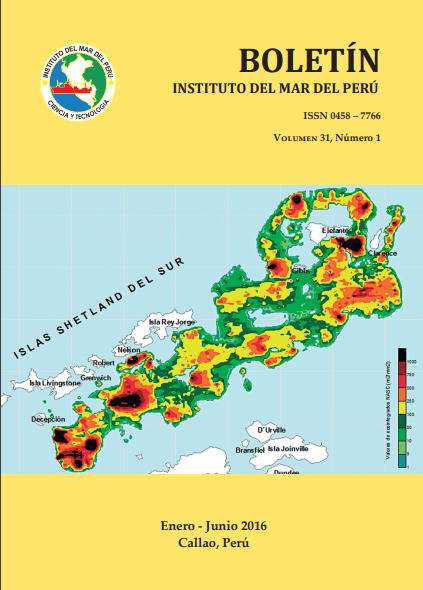
Distribution, concentration and biomass krill (Euphausia superba) in the austral summer of 2007 in the Bransfield Strait
Keywords:
Euphausia superba, krill, biomass, AntarcticaAbstract
We estimated the biomass of krill in the area Bransfield Strait and around Elephant Island during the austral summer of 2007, for the frequency of 38 kHz was estimated biomass of 2’816,083 tons, while for the frequency of 120 kHz was 2’977,414 tons, the largest biomass are located in latitude 61 and 62°S and 54, 56°W degrees longitude. According to the first experiment between Elephant and Clarence Islands, in order to observe the behavior of swarms of krill and its relation to the hourly variations, we determined that predominate during the 03- 04 hours and 15-16 hours, vertically were detected between 50-200 m depth. In the second experiment was conducted in Admiralty Bay in order to study the dynamics of the ecosystem and the movement of krill aggregations, it was found to predominate mainly between 10-11 hours with average depths of 70-80 m.
Downloads
Metrics
References
Demer D, Conti S. 2005. New target-strength model indicates more krill in the Southern Ocean. ICES Journal of Marine Science, 62: 25-32.
Jolly G M, Hampton I. 1990. A stratified random transect design for acoustic surveys of fish stocks. Canadian Journal of Fisheries and Aquatic Science. 47: 1282–1291.
Gutiérrez M, Peraltilla S, Bertrand A, Castillo R, Gonzales A, Swartzman G. 2006. Informe Anual Proyecto Copepod 1. Resultados del Área de Detección y Comportamiento.
Downloads
Published
How to Cite
Issue
Section
License
Copyright (c) 2016 Instituto del Mar del Perú

This work is licensed under a Creative Commons Attribution 4.0 International License.
© Bol Inst Mar Perú. La revista retiene los derechos patrimoniales de los autores con la finalidad de garantizar el acceso abierto de los manuscritos.
Todos los manuscritos publicados en la revista se distribuyen bajo la licencia “Creative Commons Atribución - NoComercial - CompartirIgual 4.0 Internacional” (CC BY-NC-SA 4.0). Implica que autores y lectores pueden de forma gratuita descargar, almacenar, copiar, redistribuir, remezclar, transformar o generar obras derivadas a partir del manuscrito, siempre y cuando mencionen la fuente primaria de publicación y la autoría del manuscrito, así como que se realice sin fines comerciales y se distribuya bajo la misma licencia que el original. Puede consultar desde aquí la versión informativa y el texto legal de la licencia.


