Fitoplancton del estrecho de Bransfield e isla Elefante durante el verano austral 2006
Palabras clave:
Fitoplancton, Antártida, estructura comunitaria, distribución, diversidadResumen
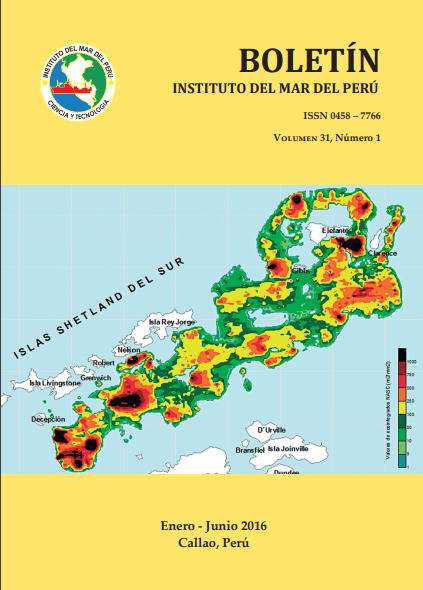
Durante el verano austral 2006, se estudió la distribución y estructura de la comunidad fitoplanctónica en el estrecho Bransfield y la isla Elefante. Las muestras de agua se tomaron con botella Niskin a diferentes profundidades. El análisis cuantitativo se realizó según el método de sedimentación de Utermöhl. Los valores integrados de densidad para la columna de agua de la superficie a 100 m de profundidad, mostraron valores mayores de 300,000 celx103.m-2. Las especies dominantes fueron: Fragilariopsis sp., Thalassiosira antarctica, Pseudonitzschia prolongatoides, P. delicatissima y Porosira glacialis. Verticalmente las mayores densidades se encontraron entre 0 y 30 m de profundidad. Con pocas excepciones el fitoplancton estuvo dominado por los microflagelados (78%), el segundo grupo en importancia fue el de las diatomeas (18%). Los valores del índice de diversidad fueron menores de 1,6 bits/cel. En el área de estudio el fitoplancton mostró alta homogeneidad evidenciada por alta similaridad entre muestras (90%).
Descargas
Métricas
Citas
Balech E. 1976. Clave Ilustrada de Dinoflagelados Antárticos. Publicación N°11. Instituto Antártico Argentino. Buenos Aires. 1-99.
Brandini F, Kutner M B. 1986. Composition and Distribution of Summer Phytoplankton in the Bransfield Strait, Antartica. An. Acad. Cienc., 58 (Suplemento).
Detmer A E, Bathmann U V. 1997. Distribution patterns of autotrophic pico- and nanoplancton and their relative contribution to algal biomass during spring in the Atlantic sector of the Southern Ocean. Deep Sea Res. 44: 299-320.
Estrada M. 1985. Biomasa y producción fitoplanctónica en el mar de Weddell y costas de la Península Antártica. Actas del Primer Simposio Español de Estudios Antárticos.: 175-188.
Frenguelli J. 1943. Diatomeas de las Orcadas del Sur. Revista del Museo de la Plata Tomo V, Botánica N° 21. La Plata. Argentina.
Frenguelli J, Orlando H. 1958. Diatomea y Silicoflagelados del sector Antártico Sud Americano. Publicación N° 5. Instituto Antártico Argentino. Buenos Aires.
Hasle G R. 1978. The inverted-microscope method. En: (Ed. A. Sournia) Phytoplankton manual. UNESCO, Paris, Oceanographic Methodology 6: 88-96.
Hasle G, Steindinger K, Syvertsen E, Tangen K. 1996. Identifying Marine Diatoms and Dinoflagellates. Editor. Carmelo, R. Tomas. Academic Press, Inc. A Division of Harcourt Brace & Company. San Diego.
Lillo S, Guzmán O. 1982. Estudio de la abundancia y comportamiento del Krill (Euphausia superba) aplicando técnicas hidroacústicas. Pub. Inst. Antártico. Chil. Ser. Cie. N° 28: 23-55.
Margalef R. 1972. Regularidad de la distribución de la diversidad del fitoplancton en un área del Mar Caribe. Invest. Pesq. 26(2): 241-264.
Medlin L, Priddle J. 1990. Polar Marine Diatoms. British Antarctic Survey. Natural Environment Research Council. Perrin R A, Lu P, Marchant H J. 1987. Seasonal variation in marine phytoplankton and ice algae at a shallow Antartic coastal site. Hydrobiologia 146: 33-46.
Pinto G, Aguirre A, Calixto R. 1999. Estudio de la Línea base ambiental de la Ensenada Mackellar. CONCYTEC Inf. Actividades Cient. X Exp. Antar. Perú.
Priddle J, Fryxell G. 1985. Handbook of the Common Plankton Diatoms of the Southern Ocean. Centrals except the Genus Thalassiosira. British Antarctic Survey. Natural Environment Research Council.
Shannon C, Weaver W. 1963. The mathematical theory of communication. University of Illinois Press Urbana. 125 pp.
Sournia A, Grall J R, Jacques G. 1979. Diatomées et Dinoflagellés planctoniques d’une coupe méridienne dans le sud de l’océan Indien (campagne Antiprod I du Marion-Dufresne, mars 1977). Botanique Marina. Vol. XXII, pp. 183-198.
Sundström B G. 1986. The Marine Diatom Genus Rhizosolenia. A new approach to the taxonomy. Doctoral Dissertation, Lund University, Sweden. 117 pp, 39 plates.
Thröndsen J, Heimdal B. 1993. Marine Phytoplankton. A Guide to Naked Flagellates and Coccolithophorid. Editor. Carmelo R. Thomas. Academic Press, Inc. A Division of Harcourt Brace & Company. San Diego.
Uribe E. 1982. Influence of the phytoplankton and primary production of the Antartic waters in relationship with the distribution and behavior of krill. INACH, Scientific Series 28: 147-163.
Vanucci S, Mangoni O. 1999. Pico and Nano phytoplankton Assemblages in a Sub Antartic Ecosystem: The Strait of Magellan. Botanica Marina Vol. 42: 563-572.
Descargas
Publicado
Cómo citar
Número
Sección
Licencia
Derechos de autor 2016 Instituto del Mar del Perú

Esta obra está bajo una licencia internacional Creative Commons Atribución 4.0.
© Bol Inst Mar Perú. La revista retiene los derechos patrimoniales de los autores con la finalidad de garantizar el acceso abierto de los manuscritos.
Todos los manuscritos publicados en la revista se distribuyen bajo la licencia “Creative Commons Atribución - NoComercial - CompartirIgual 4.0 Internacional” (CC BY-NC-SA 4.0). Implica que autores y lectores pueden de forma gratuita descargar, almacenar, copiar, redistribuir, remezclar, transformar o generar obras derivadas a partir del manuscrito, siempre y cuando mencionen la fuente primaria de publicación y la autoría del manuscrito, así como que se realice sin fines comerciales y se distribuya bajo la misma licencia que el original. Puede consultar desde aquí la versión informativa y el texto legal de la licencia.


