Distribución, abundancia y proximidad espacial de enjambres de krill (Euphausia superba) en el estrecho de Bransfield y alrededores de la isla Elefante, verano austral 2006
Palabras clave:
Euphausia superba, krill, estrecho de Bransfield, isla Elefante, distribuciónResumen
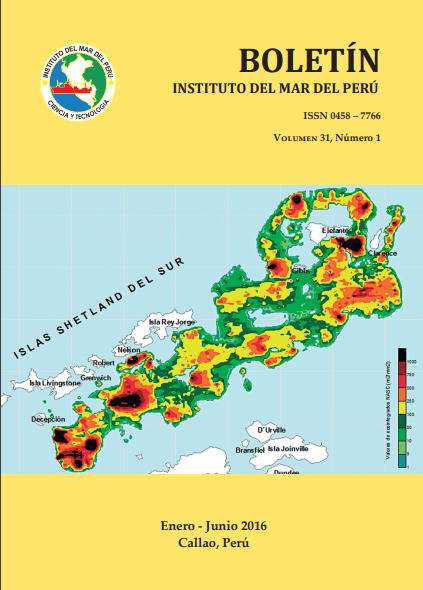
Se realizó a bordo del BIC Humboldt una prospección de pequeña escala entre las islas Elefante, Clarence y Gibbs, además de una evaluación sinóptica a lo largo del estrecho de Bransfield, en enero 2006, con la finalidad de medir la distribución, abundancia y proximidad de enjambres de krill (Euphausia superba) en relación con sus depredadores. Los resultados más saltantes fueron: (i) la abundancia de krill se halló en el valor más bajo de la serie construida por el Instituto del Mar del Perú (IMARPE) desde 1988, habiéndose calculado 425 mil toneladas de krill (CV: 35%) bajo la hipótesis de que la relativa ausencia de hielos durante la prospección ha retraído la mayor parte de la población sobre las costas de la península Antártica, fuera del alcance del barco de investigación, (ii) la distribución del krill arrastraría a la de sus depredadores a juzgar por las variaciones sincrónicas que se observó entre cada uno de los nueve giros sobre un área de 18 mn2 que se efectuó entre las islas Elefante, Clarence y Gibbs, (iii) el ascenso del krill hacia la superficie implica una disminución temporal en su capacidad de retrodispersión acústica, lo que confirmaría que este fenómeno se explica por la variación temporal del ángulo de natación del krill durante sus migraciones verticales. Se concluye que el análisis de estos hallazgos debe ser profundizado a través de nuevos experimentos sobre escalas geográficas más amplias.
Descargas
Métricas
Citas
Agnew D J. 1992. Distribution of krill (Euphausia superba Dana) catches in the South Shetlands and South Orkneys. In: Selected Scientific Papers 1992 (SC-CAMLR-SSP/9). Commission for the Conservation of Antarctic Marine Living Resources, Hobart, Australia, pp. 287–303.
Alonso S H, Switzer P V, Mangel M. 2003. An ecosystembased approach to management: using individual behavior to predict the indirect effects of Antarctic krill fisheries on penguin foraging. Journal of Applied Ecology 40, 692-702.
Arntz W. 1997. Investigación Antártica en biología marina: situación actual, proyectos internacionales y perspectivas. Bol. R. Soc. Esp. Hist. Nat. (Sec. Biol.), 93 (1-4), 13-44.
CCAMLR. 2005. Report of the first meeting of the Subgroup on Acoustic Survey and Analysis Methods (SG-ASAM). 25 pp.
De Robertis A C, Schell J. 2003. Acoustic observations of the swimming behaviour of the euphausiids Euphausia pacifica Hansen. ICES Journal of Marine Science, 60: 885- 898.
Demer D A, Conti S. G. 2003. Reconciling theoretical versus empirical target strengths of krill; effects of phase variability on the distorted-wave Born-approximation. ICES Journal of Marine Science, 60(2): 429-434.
Demer D, Conti S. 2005. New target-strength model indicates more krill in the Southern Ocean. ICES Journal of Marine Science, 62: 25-32.
Greene C H, Stanton T K, Wiebe P H, Mc Clatchie S. 1991. Acoustic estimates of Antarctic krill. Nature, 349: 110.
Greenlaw C, Johnson R. 1983. Multiple frequency acoustical estimation. Biological Oceanography, Vol.2, Number 2, 3-4: 227-252.
Gutiérrez M. 1998. Biomass and distribution of krill (Euphausia superba) in the Bransfield Strait during the Peruvian ANTAR Expeditions I, II and III. 1998. Korean Journal of Polar Research 8 (1, 2): 117-125.
Hastie T, Tibshirani R. 1990. Generalized Additive Models. Chapman and Hall, London, UK.
Hewitt R P, Demer D A, Emery J H. 2003. An eight-year cycle in krill-biomass density inferred from acoustic surveys conducted in the vicinity of the South Shetland Island during the austral summers of 1991/1992 through 2001/2002. Aquatic Living Resources, 16(3): 205-213.
Hewitt R, Kim S, Naganobu M, Gutierrez M, Kang D, Takao Y, Quinones J, Leeg Y-H, Shing H, Kawaguchi S, Emery J H, Demer D A, Loeb V J. 2004. Variation in the biomass density and demography of Antarctic krill in the vicinity of the South Shetland Islands during the 1999/2000 austral summer. Deep-Sea Research II 51: 1411–1419.
Higginbottom I R, Pauly T J, Heatley D C. 2000. Virtual echograms for visualization and post-processing of multiple-frequency echo sounder data. Proceedings of the Fifth European Conference on Underwater Acoustics, ECUA 2000 (Ed. M.E. Zakharia), 1497-1502. Holliday D V. 1977. Extracting biophysical information from acoustic signatures of marine organisms. Oceanic Sound Scattering Prediction. Edited by N. Andersen and B. Zahuraneo, Plenum Press: 619-624.
ICES. 2002. Noise radiation measurements aboard Research Vessels. Cooperative Research Report Nº 255, International Council for the Exploration of the Sea, 74 pp.
Jolly G M, Hampton I. 1990. A stratified random transect design for acoustic surveys of fish stocks. Canadian
Journal of Fisheries and Aquatic Science 47, 1282–1291.
Kils U. 1981. The swimming behaviour, swimming performance and energy balance of Antarctic krill Euphausia superba. BIOMASS Scientific Series No. 3.122 pp.
Kirkwood J. 1982. Anare Research Notes, Australian National Antartic Research Expeditions, a guide to the Euphausiacea of the Southern Ocean. Antartic Division, Kingston, Tasmania Australian. Mac Caulay M. 1987. Biomass estimates of krill in the Bransfield Strait-Elephant Island ecosystem monitoring area of CCAMLR. CCAMLR. McCall A D. 1990. Dynamic Geography of Marine Fish Populations. University of Washington Sea Grant Program, Seattle.158 pp.
Miller D, Hampton I. 1990. Biology and Ecology of the Antartic Krill (Euphausia superba). BIOMASS Scientific Series 9.Cambridge, England.
Siegel V, Trathan P N, Emery J H, Everson I, Miller D GM. 2004. Biomass of Antarctic krill in the Scotia Sea in January/February 2000 and its use in revising an estimate of precautionary yield. Deep-Sea Research II. [doi: 10.1016/j.dsr2.2004.06.011].220–230.
Simmonds J N, MacLennan D N. 2005. Fisheries Acoustics, second edition. Chapman and Hall Books series, London, 480 pp.
Sun S. 1997. Using Antarctic krill as an indicator of environmental interannual change. Korean Journal of Polar Research Vol 8 (1 2): 97-103.
Venables W N, Ripley B D. 1994. Modern Applied Statistics with S-Plus. New York: Springer –Verlag.
Watkins J L, Naganobu M, Sushin V A, Brierley A S, Demer D A, Kasatkina S, Takao Y, Goss C, Malyshko A, Brandon M A, Kawaguchi S, Siegel V, Trathan P N, Emery J H, Everson I, Miller D G M. 2004. Biomass of Antarctic krill in the Scotia Sea in January/February 2000 and its use in revising an estimate of precautionary yield. Deep-Sea Research II, this issue [doi: 10.1016/j. dsr2.2004.06.011]. 220–230.
Descargas
Publicado
Cómo citar
Número
Sección
Licencia
Derechos de autor 2016 Instituto del Mar del Perú

Esta obra está bajo una licencia internacional Creative Commons Atribución 4.0.
© Bol Inst Mar Perú. La revista retiene los derechos patrimoniales de los autores con la finalidad de garantizar el acceso abierto de los manuscritos.
Todos los manuscritos publicados en la revista se distribuyen bajo la licencia “Creative Commons Atribución - NoComercial - CompartirIgual 4.0 Internacional” (CC BY-NC-SA 4.0). Implica que autores y lectores pueden de forma gratuita descargar, almacenar, copiar, redistribuir, remezclar, transformar o generar obras derivadas a partir del manuscrito, siempre y cuando mencionen la fuente primaria de publicación y la autoría del manuscrito, así como que se realice sin fines comerciales y se distribuya bajo la misma licencia que el original. Puede consultar desde aquí la versión informativa y el texto legal de la licencia.


