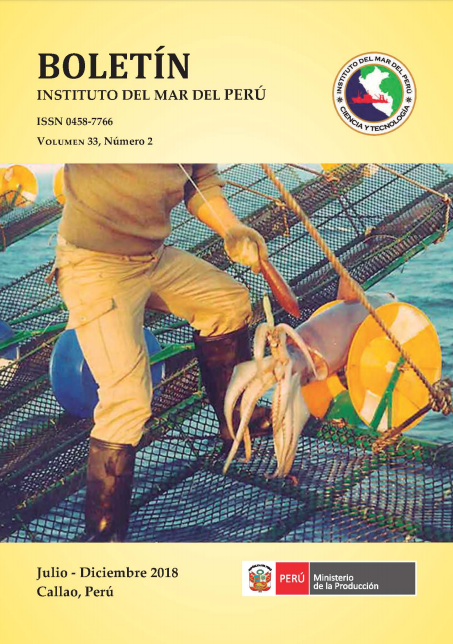
Sistema de monitoreo de la pesquería del calamar gigante Dosidicus gigas en el Perú
Palabras clave:
Dosidicus gigas, sistema de monitoreo, pesquería, PerúResumen
Se presenta la metodología para la obtención de información biológica, pesquera y poblacional del calamar gigante o pota Dosidicus gigas en el mar peruano que se aplica en el Instituto del Mar del Perú, para el registro sistemático de estadísticas de pesca y aspectos biológicos y poblacionales de la especie en los principales lugares de desembarque, laboratorios de investigación y a bordo de embarcaciones pesqueras y científicas. El propósito del presente documento es brindar una herramienta estandarizada de muestreo y registro de datos que contribuya a la generación de información confiable y comparable, para la adopción de decisiones oportunas orientadas al ordenamiento pesquero del calamar gigante.
Descargas
Métricas
Citas
Alegre A. 2011. Relaciones ontogénicas y espacio-temporales en la dieta del calamar gigante (Dosidicus gigas) en Perú, utilizando un Modelo Aditivo Generalizado. Tesis para optar el Grado de Magister Scientiae en Estadística Aplicada, Universidad Nacional Agraria La Molina. 113 p.
Argüelles J, Rhodhouse P, Villegas P, Castillo G. 2001. Age Growth and population structure of the jumbo flying squid Dosidicus gigas in Peruvian waters. Fisheries Research. 54: 51-61.
Argüelles J, Tafur R, Taipe A, Villegas P, Keyl F, Dominguez N, Salazar M. 2008. Size increment of jumbo flying squid Dosidicus gigas mature females in Peruvian waters, 1989–2004. Prog. Oceanogr. 79: 308-312.
Arguelles J, Tafur R. 2010. New insights on the biology of the jumbo squid Dosidicus gigas in the Northern Humboldt Current System: size at maturity, somatic and reproductive investment. Fish. Res. 106: 185-192.
Arkhipkin A I. 1991. Methods for cephalopod age and growth studies with emphasis on statolith ageing techniques. In P. Jereb, S. Ragonese y S. v. Boletzky, eds. Squid age determination using statoliths. pp. 11-17.
Arkhipkin A I, Fetisov A A. 2000. Population structure and growth of the squid Illex llecebrosus (Cephalopoda: Ommastrephidae) off Nova Scotia, north-west Atlantic. J. Mar. Biol. Assoc. U.K. 80: 967–968.
Berg J. 1979. Discussion of methods of investigating the food of fishes, with reference to a preliminary study of the prey of Gobiusculus flavescens (Gobiidae). Mar. Biol. 50: 263-273.
Cosgrove J A. 2005. The first specimens of Humboldt squid in British Columbia. PICES Press. Vol.13 (2): 30–31.
Dawe E G, Natsukari Y. 1991. Light microscopy. In P. Jereb, S. Ragonese y S. v. Boletzky, eds. Squid age determination using statoliths, pp. 83-95. Proceedings of the international workshop held in the Istituto di Tecnologia della Pesca e del Pescato, 9-14 October 1989. N.T.R.-I.T.P.P. Publ. Especial No. 1, Mazara del Vallo, Sicilia, Italia. 127 pp.
Ehrhardt N M, Solis N A, Jacquemin P S, Ortiz J, Ulloa P, Gonzáles G, García F. 1986. Análisis de la biología y condiciones del stock del calamar gigante Dosidicus gigasen el Golfo de California, México, durante 1980. Ciencia Pesquera Ins. Nal. Pesca Sria Pesca, México. 63-76.
Espino M. 2003. Estrategia de gestión ambiental para el Pacífico oriental con especial mención a la pesquería peruana. Tesis Magister en Geografía, Universidad Nacional Mayor de San Marcos, Lima. 112 pp.
Espino M. 2013. El jurel Trachurus murphyi y las variables ambientales de macroescala. En: Csirke J., R. Guevara-Carrasco & M. Espino (Eds) Ecología, Pesquería y conservación del jurel Trachurus murphyi en el Perú. Rev. Per. Biol. Número especial 20(1): 9-20.
Espino M, Yamashiro C. 2012. La variabilidad climática y las pesquerías en el Pacífico Suroriental. In: P.M. Arana (Guest Editor) International Conference: “Environment and Resources of the South Pacific” Lat. Am. J. Aquat. Res. 40(3): 705-721. DOI: 103856/vol40-issue3-fulltext-18
Espino M, Yamashiro C, Fernández F, Cárdenas G. 1995. Aspectos metodológicos relacionados con el análisis de las pesquerías y sus recursos (Guía para el seguimiento de las pesquerías). Informe Inst. Mar Perú 111: 1-34.
Field J, Baltz K, Phillips J, Walker W. 2007. Range expansion and trophic interaction of the jumbo squid, Dosidicus gigas, in the California Current. CalCofi Rep. 48: 131-146.
Guevara-Carrasco R, Mariátegui L, Yamashiro C. 2018. Aspectos de la ordenación pesquera del calamar gigante o pota (Dosidicus gigas) y la variabilidad climática en el Perú. Bol Inst Mar Perú. 33(2): 285-301.
Harman R F, Young R E, Mangold K M, Suzuki T, Hixon R F. 1989. Evidence of multiple spawning in the tropical oceanic squid Sthenoteuthis oualaniensis (Teuthoidea: Ommastrephidae). Mar. Biol. 101: 513-519.
Hatfield E M C, Hochberg F. 2006. Dosidicus gigas: northern range expansion events. In: B. Olson and J. Young (Editors). The Role of Squid in Pelagic Marine Ecosystems GLOBEC-CLIOTOP WG3 Workshop, University of Hawaii, Manoa.
Hyslop E. 1980. Stomach contents analysis-a review of methods and their applications. Journal of Fish Biology. 17 (4): 411-429.
Jereb P, Roper C F E. (Eds.) 2010. Species Catalogue for Fishery Purposes Cephalopods of the world. An annotated and illustrated catalogue of cephalopod species known to date. Volume 2, Myopsid and Oegopsid Squids. FAO Rome. Vol. 2 (4): 605 p.
Keyl F, Wolff M. Arguelles J, Mariategui L, Tafur R, Yamashiro, C. 2008. A hypothesis on range expansion and spatio-temporal shifts in size-at-maturity of jumbo squid (Dosidicus gigas) in the Eastern Pacific Ocean. CalCofi Rep. 49: 119-128.
Keyl F, Arguelles J, Tafur R. 2011. Interannual variability in size structure, age, and growth of jumbo squid (Dosidicus gigas) assessed by modal progression analysis. ICES J. Mar. Sci. 68: 507-518.
Mariátegui L, Tafur R, Limachi S. 2009. Plan para obtener información a bordo de buques calamareros. Curso de Capacitación Técnicos Científicos de Investigación (TCI) en barcos pesqueros, Callao-Perú. 110-129.
Mariátegui L, Pizarro L, Blaskovic V, Goicochea C, Vásquez L, Marquina R, Crispin A. 2011. El calamar gigante Dosidicus gigas en el mar peruano. Crucero B/P Hakurei Maru N° 8, primavera 2010 y verano 2011. Inf. Inst. Mar Perú. 38(4): 395-413.
Markaida U. 2001. Biología del calamar gigante Dosidicus gigas Orbigny, 1835 (Cephalopoda: Ommastrephidae) en el Golfo de California, México. Tesis de Grado de Doctor en Ciencias, Centro de Investigación Científica y de Educación Superior de Ensenada, Baja California, México. 426 p.
Nesis K N. 1983. Dosidicus gigas. In: P. R. Boyle (Ed.) Cephalopod Life Cycles. Volume I: Species Accounts, London, Academic Press. 475 pp.
Nigmatullin Ch M, Nesis K N, Arkhipkin A I. 2001. A review of the biology of the jumbo squid Dosidicus gigas(Cephalopoda: Ommastrephidae). Fisheries Research. 54: 9-19.
Ñiquen M, Chipollini A, Echevarría A, Mori J, Buitrón b. 2004. Cambios biológicos en los principales recursos marinos peruanos en el verano 2001. Inf. Inst. Mar Perú-Callao. 32(1): 57-62.
Okutani T. 2015. Cuttlefishes and squids of the world (New Edition). Publication of the 50th Anniversary of the Foundation of National Cooperative Association of Squid Processors. 246 p.
Paulino C, Segura M, Chacón G. 2016. Spatial variability of jumbo flying squid (Dosidicus gigas) fishery related to remotely sensed SST and chlorophyll-a concentration (2004-2012). Fisheries Research,173(2), 122-127. http://dx.doi.org/10.1016/j.fishres.2015.10.006
Perea A, Sánchez J, Buitrón B. 2018. Escala de madurez gonadal del calamar gigante Dosidicus gigas (d’Orbigny; 1835) (Cephalopoda:Ommastrephidae). Bol Inst Mar Perú. 33(2): 137-152.
Pierce D J, Mahmoudi B, Wilson R R Jr. 2001. Age and growth of the scaled herring, Harengula jaguana, from Florida waters, as indicated by microstructure of the sagittae. Fish. Bull. 99: 202–209.
Rocha F, Guerra A, Gonzalez A F. 2001. A review of reproductive strategies in cephalopods. Biol. Rev. 76: 291-304.
Rocha F, González A F, Rasero M, Guerra A, Castro B G, Cortez T. 1996. An overview on the reproductive strategies in Cephalopoda. ICES Working Group on Cephalopod Fisheries and Life History. Abstract (April 1996, Lisbon, Portugal)
Rodhouse P G. 2001. Managing and forecasting squid fisheries in variable environments. Fisheries Research. 54: 3-8.
Rosa R, Yamashiro C, Markaida U, Rodhouse P, Waluda C, Salinas-Zavala C, Keyl F, O ́Dor R, Stewart J, Gilly W. 2013. Dosidicus gigas, Humboldt Squid. In: R Rosa, R O’Dor and GJ Pierce (Eds). Advances in Squid Biology, Ecology and Fisheries Part II Oegopsid Squids, Nova Science Publishers, Inc., New York. pp. 169-206.
Sánchez J. 2011. Escala de madurez gonadal y fecundidad de Dosidicus gigas (D’Orbigny, 1835) (Mollusca: Cephalopoda) ‘calamar gigante’ o ‘pota’. Tesis para optar el Título Profesional de Licenciado en Biología, Universidad Nacional Federico Villarreal. Lima-Perú., 90 p.
Sparre P, Venema S C. 1992. Introduction to tropical fish stock assessment. Part I. Manual. FAO Rome. Fisheries Technical Paper 306, Rev. 1, 376 p.
Staaf D J, Camarillo-Coop S, Haddock S H D, Nyack A C, Payne J, Salinas-Zavala C A, Seibel B A, Trueblood L, Widmer C, Gilly W F. 2008. Natural egg mass deposition by the Humboldt squid (Dosidicus gigas) in the Gulf of California and characteristics of hatchlings and paralarvae. J. Mar. Biol. Assoc.UK. 88(4): 759–770. doi:10.1017/S0025315408001422
Tafur R, Castillo G, Flores D, Tejada A, Zeballos J, Chambilla J, Sanz Y, Torres E, Muñoz R, Ramirez A, Ramirez P, Sanjinez M. 2013. Protocolo de salidas a la mar a bordo de embarcaciones marisqueras. Informe Interno Inst. Mar Perú. 22 p.
Yatsu A, Midorikawa S, Shimada T, Uozumi Y. 1997. Age and growth of the neon flying squid, Ommastrephes bartrami, in the North Pacific Ocean. Fish. Res. 29: 257-270.
Zeidberg L, Robison B. 2007. Invasive range expansion by the Humboldt squid, Dosidicus gigas in the eastern North Pacific. Proceedings of the National Academy.
Descargas
Publicado
Cómo citar
Número
Sección
Licencia
Derechos de autor 2018 Instituto del Mar del Perú

Esta obra está bajo una licencia internacional Creative Commons Atribución 4.0.
© Bol Inst Mar Perú. La revista retiene los derechos patrimoniales de los autores con la finalidad de garantizar el acceso abierto de los manuscritos.
Todos los manuscritos publicados en la revista se distribuyen bajo la licencia “Creative Commons Atribución - NoComercial - CompartirIgual 4.0 Internacional” (CC BY-NC-SA 4.0). Implica que autores y lectores pueden de forma gratuita descargar, almacenar, copiar, redistribuir, remezclar, transformar o generar obras derivadas a partir del manuscrito, siempre y cuando mencionen la fuente primaria de publicación y la autoría del manuscrito, así como que se realice sin fines comerciales y se distribuya bajo la misma licencia que el original. Puede consultar desde aquí la versión informativa y el texto legal de la licencia.


