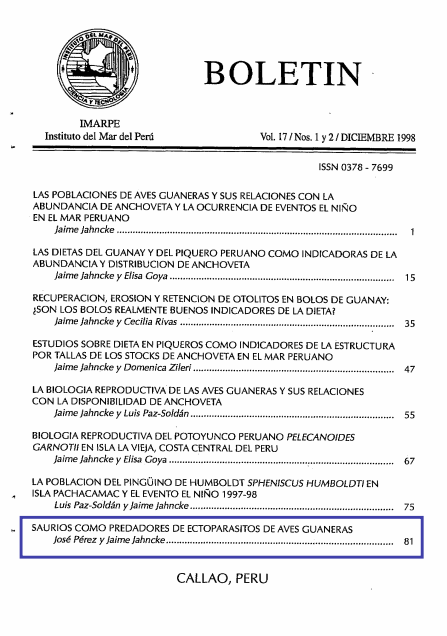
Breeding biology of Peruvian guano-producing seabirds and its relationship with Peruvian anchovy availability
Keywords:
Guano birds, breeding biology, Sula variegata, Leucocarbo (Phalacrocorax) bougainvillii, Pelecanus thagus, Sula nebouxiiAbstract
Reproductive characteristics of Peruvian Guano-birds are presented with emphasis on Peruvian Boobies Sula variegata. Chick growth parameters for Peruvian Boobies, Guanay Cormorants, Peruvian Pelicans and Blue Footed Boobies on Lobos de Tierra, Macabi and Mazorca islands and Punta San Juan were analyzed. Larger growth rates were found for chicks hatched in summer. This is related to the larger food availability during this season. Fledglings weights of mentioned species were compared by colony size and season. Guanay Cormorants fledgling weights on Macabi and San Juan (medium and small colonies) were higher than those in Mazorca (large colony) in the same season. The heaviest Peruvian Booby fledglings were found in Macabi and San Juan in summer. Peruvian Boobies breeding season coincides with the higher food availability during this season; this pattern has been affected by El Niño event 97-98. Breeding season on Macabi and Mazorca are similar; however, breeding success in Mazorca is twice that in Macabi. A high rate of lost eggs due to higher colony density and related to territorial competence was found in Macabi.
Downloads
Metrics
References
ARNTZ, W y E. FAHRBАСH. 1996. El Niño; Experimento climático de la naturaleza. Fondo de Cultura económica. Mexico. 312 pp.
BOERSMA, P. D. 1990. Asynchronous hatching and food allocation in the magellanic penguin Spheniscus magallanicus. p: 961-973. Acta XX Congressus Internationalis Ornithologici. Volume II. Christchurch, New Zealand.
CAIRNS, D. K. 1987. Seabirds as indicators of marine food supplies. Biological Oceanography 5: 261-271.
CCAMLR. 1991. Ecosystem monitoring program: Standard methods for monitoring studies. CCAMLR. Hobart, Tasmania, Australia. 131 pp.
FRANCK, D. у Р. Н. ВЕСКER. 1992. Body mass and nest relief in common terns Stena hirundo exposed to different feeding conditions. Ardea 80: 57-69.
FURNESS, R. W. y P. MONAGHAN. 1987. Seabird ecology. Blackie and Son Ltd. Glasgow and London. 164 pp.
GUERRA, C. y M. CIKUTOVIC. 1984. Algunos aspectos de la nidificación y el crecimiento de Pelecanus occidentalis thagus Molina, 1782 en el Norte de Chile. En: STILES, G. y P. AGUILAR (Eds.). Primer Symposio de Ornitología Neotropical. Arequipa, Perú.
HAHN, D. C. 1981. Asynchronous hatching in the laughing gull: cutting losses and reducing rivalry. Animal Behavior 29: 421-427.
JAHNCKE, J. y E. GOYA. 1997. Variación latitudinal y estacional en la dieta del guanay (Leucocarbo bougainvillii) y el piquero peruano (Sula variegata) en la costa peruana. Bol. Inst. Mar Perú 16 (1): 23-41.
JAHNCKE, J., GARCÍA-GODOS, A. y E. GOYA. 1997. La dieta del guanay Leucocarbo bougainvilli y del piquero peruano Sula variegata en la costa peruana en abril-mayo de 1997. Inf. Inst. Mar Perú 126: 75-86.
JORDÁN, R. 1982. La anchoveta y su captura frente a las costas del Perú. p: 51-63. En: CASTILLA, J. C. (Ed.). Bases biológicas para el uso y manejo de recursos naturales renovables: Recursos biológicos marinos. Segundo seminario taller. Monografías Biológicas (2).
JORDÁN, R. y A. CHIRINOS. 1965. La anchoveta (Engraulis ringens) conocimiento actual sobre su biología, ecología y pesquería. Inf. Inst. Mar Perú. 6: 1-52.
LACK, D. 1954. The natural regulation of animal numbers. Oxford University Press, New York.
LECROY, M. y S. LECROY. 1974. Growth and fledging in the common tern (Sterna hirundo). Bird-banding 45 (4): 326-340.
NISBET, I., J. SPENDELOW y J. HATFIEL. 1995. Variations in growth of Rosetate Tern chicks. The Condor 97: 335-344.
PATERSON, I. J. 1980. Territorial behaviour and the limitation of population density. Ardea 68: 53-62.
RICKLEFS, R. 1967. A graphical method of fitting equations to growth curves. Ecology 48(6): 978-983.
RICKLEFS, R. 1968. Patterns of growth in birds. Ibis 110: 419-451.
RICKLEFS, R. y C. WHITE. 1975. A method for constructing nesting growth curves from brief visits to seabird colonies. Bird-Banding 46: 135-140.
RICKLEFS, R., D. DUFFY y M. COULTER. 1984. Weight gain of Blue-footed booby chicks: an indicator of marine resources. Ornis Scandinavica 15: 162-166.
SOULÉ, M. E. y B. A. WILCOX (Eds). 1980. Conservation biology. Sinauer associates, Sunderland, Mass. 395 pp.
SPIEGEL, M. 1970. Estadística. Serie SCHAUM. 356 рр.
STEEL, R. G. D. y J. H. TORRIE. 1985. Bioestadística: Principios y procedimientos. Mc Graw-Hill. Bogotá. Colombia. 623 pp.
TOVAR, H., V. GUILLEN y M. E. NAKAMA. 1987. Monthly population size of three guano bird species of Perú, 1953 to 1992. р: 208-218. En: PAULY, D. e I. TSUKAYAMА (Eds.). The Peruvian anchoveta and its upwelling ecoystem: Three decades of change. ICLARM Studies and Reviews 15. 351 pp. IMARPE, GTZ, ICLARM, Manila, Philippines.
VAN HEEZIK, Y. y L. DAVIS. 1990. Effects of food variability on growth rates, fledging sizes and reproductive success in the Yellow-eyed penguin Megadyptes antipodes. lbis 132: 354-365.
WILLIAMS, T. y J. CROXALL. 1990. Is chick fledging weight a good index of food availability in seabird populatiors?. Oikos 59(3): 414-416.
WILLIAMS, T. y J. CROXALL. 1991. Chick growth and survival in gentoo penguins (Pygoscelis papua): effect of hatching asynchronic and variation in food supply. Polar Biol. 11: 197-202.
WILSON, R. 1992. Environmental monitoring with seabirds. Do we need addirional technology?. S. Afr. J. Mar. Sci. 12: 919-926.
Downloads
Published
How to Cite
Issue
Section
License
Copyright (c) 1998 Instituto del Mar del Perú

This work is licensed under a Creative Commons Attribution 4.0 International License.
© Bol Inst Mar Perú. La revista retiene los derechos patrimoniales de los autores con la finalidad de garantizar el acceso abierto de los manuscritos.
Todos los manuscritos publicados en la revista se distribuyen bajo la licencia “Creative Commons Atribución - NoComercial - CompartirIgual 4.0 Internacional” (CC BY-NC-SA 4.0). Implica que autores y lectores pueden de forma gratuita descargar, almacenar, copiar, redistribuir, remezclar, transformar o generar obras derivadas a partir del manuscrito, siempre y cuando mencionen la fuente primaria de publicación y la autoría del manuscrito, así como que se realice sin fines comerciales y se distribuya bajo la misma licencia que el original. Puede consultar desde aquí la versión informativa y el texto legal de la licencia.


