Algunos aspectos de biología y ecología del krill (Euphausia superba), estrecho de Bransfield e isla Elefante, verano austral 2007 (ANTAR XVII)
Palabras clave:
Euphausia superba, krill, tallas, comunidad pelágica, dieta, AntártidaResumen
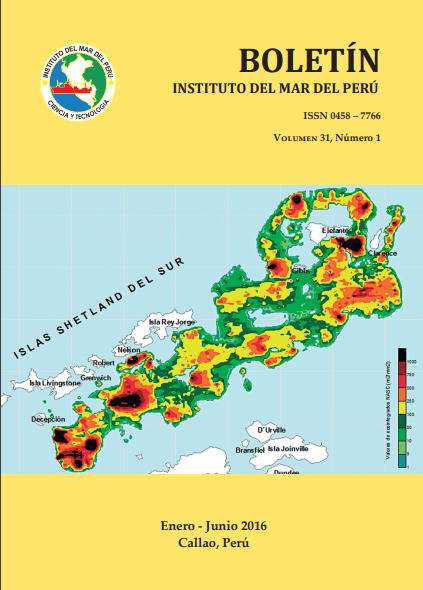
Se describen los resultados de algunos aspectos de la biología y ecología del krill antártico Euphausia superba a lo largo del estrecho de Bransfield y alrededores de la isla Elefante (Primera Fase) y entre las islas Elefante y Clarence (Segunda Fase), obtenidos del 17 al 23 de enero 2007 a bordo del BIC Humboldt. Se efectuaron 25 lances experimentales de pesca: 13 correspondieron a la primera fase y 12 a la segunda. La captura total fue 6.852 kg, el 99% fue krill antártico. La distribución vertical del krill antártico estuvo entre 25 y 50 m de profundidad en el estrecho de Bransfield; en las islas Elefante y Clarence, se localizaron a mayor profundidad (50-75 m). La estructura por tamaños de E. superba mostró dos modas marcadas, una conformada por individuos sub adultos (43 mm de longitud total-LT) y otra por juveniles (28-30 mm LT). Por zonas, los juveniles fueron representativos en el estrecho de Bransfield y en el Frente oceánico; en tanto que los adultos (principalmente hembras grávidas) con mayor peso corporal se encontraron en las islas Elefante y Clarence. Entre las 04:00 y 12:00 horas los ejemplares estuvieron moderada e intensamente alimentados; mientras que, entre las 16:00 y 20:00 horas ligeramente alimentados. La dieta del krill estuvo constituida por elementos fitoplanctónicos (diatomeas, dinoflagelados y tintínidos). No se observó diferencias notables de la dieta del krill respecto a los tamaños, horas del día y profundidad de captura.
Descargas
Métricas
Citas
Alonzo S H, Switzer P V, Mangel M. 2003. An ecosystembased approach to management: using individual behaviour to predict the indirect effects of Antarctic krill fisheries on penguin foraging. Journal of Applied Ecology 40: 692-702.
Atkinson A, Siegel V, Pakhomov E, Rothery P. 2004. Longterm decline in krill stock and increase in s alps within the Southern Ocean. Nature (Vol. 432): 100-103.
Boyd C M, Heyraud M, Boyd C N. 1984. Feeding of the Antarctic krill, Euphausia superba. Journal of Crustacean Biology 4 (spec. 1): 123-141.
Cárdenas G, Pellón J, Franco M, Espinoza P. 2007. Algunos aspectos de la biología y ecología del krill antártico, Euphausia superba en el Estrecho de Bransfield e Isla Elefante, durante el verano austral del 2006 (ANTAR XVI). En: Informe Anual del proyecto COPEPOD I, Biología, Ecología de las principales comunidades pelágicas del estrecho de Bransfield y alrededores de la isla Elefante.
CCAMLR. 1999. Manual del Observador Científico. CCAMLR, Hobart, Australia.
Clarke K R. 1993. Non parametric multivariate analysis of changes in community structure. Australian Journal of Ecology, 18: 117-143.
Cripps G C, Hill H J. 1998. Changes in lipid composition of copepods and Euphausia superba associated with diet and environmental conditions in the marginal ice zone, Bellinghausen Sea, Antarctica. Deep-See Research 45: 1357-1381.
Falk-Petersen S, Hopkins C C E, Sargent J R. 1990. Trophic relationships in the pelagic arctic food web. In Trophic relationships in the marine environment. Edited by M. Barnes and R.N. Gibson. Aberdeen University Pressm Aberdeen, Scotland, pp: 315-333.
Falk-Petersen S, Hagen W, Kattner G, Clarkea, Sargent J. 2000. Lipids, trophic relationships, and biodiversity in Arctic and Antarctic krill. Canadian Journal of Fisheries and Aquatic Sciences 57 (Suppl. 3): 178-191.
Fernandes L. 1999. Tintinidos (Ciliophora - Subordem Tintinnina) de águas subantárticas e antárticas entre a Argentina e a Península Antártica (35°S-62°S) (novembro 1992). Rev. Brás oceanogr. 47(2):155-171.
Frenguelli J. 1943. Diatomeas de las Orcadas del Sur. Revista del Museo de La Plata Tomo V (Botánica Nº 21).
Frenguelli O, Orlando H. 1958. Diatomeas y silicoflagelados del sector antártico sudamericano. Publicación N° 5. Instituto Antártico Argentino. 191 pp.
Gascón V, Werner R. 2005. El krill antártico: estudio de caso sobre implicaciones de la pesca en el ecosistema. Antarctic and Southern Ocean Coalition, 31 pp.
Hasle G R, Syvertsen E E. 1996. Marine diatoms. En, Tomas, C. R. (Ed.) Identifying Marine Diatoms and Dinoflagellates. Academic Press, Inc., 5-385 pp.
Hopkins T L, Lancraft T M, Torres J J, Donelley J. 1993. Community structure and trophic ecology of zooplankton in the Scotia Sea marginal ice zone in winter (1988), Deep-sea Research 40: 81-105.
Meyer M A, El Sayed S Z. 1983. Grazing of Euphausia superba Dana on natural phytoplankton populations. Polar Biology 1: 193-197.
Price H J, Boyd K R, Boyd C M. 1988. Omnivorous feeding behavior of the Antarctic krill Euphausia superba. Marine Biology 97: 67-77.
Schmidt K, Mc Clelland J W, Mente E, Montoya J P, Atkinson A, Voss M. 2004. Trophic-level interpretation based on d15 N values: implications of tissue-specific fractionation and amino acid composition. Marine Ecology Progress Series 266: 43-58.
Descargas
Publicado
Cómo citar
Número
Sección
Licencia
Derechos de autor 2016 Instituto del Mar del Perú

Esta obra está bajo una licencia internacional Creative Commons Atribución 4.0.
© Bol Inst Mar Perú. La revista retiene los derechos patrimoniales de los autores con la finalidad de garantizar el acceso abierto de los manuscritos.
Todos los manuscritos publicados en la revista se distribuyen bajo la licencia “Creative Commons Atribución - NoComercial - CompartirIgual 4.0 Internacional” (CC BY-NC-SA 4.0). Implica que autores y lectores pueden de forma gratuita descargar, almacenar, copiar, redistribuir, remezclar, transformar o generar obras derivadas a partir del manuscrito, siempre y cuando mencionen la fuente primaria de publicación y la autoría del manuscrito, así como que se realice sin fines comerciales y se distribuya bajo la misma licencia que el original. Puede consultar desde aquí la versión informativa y el texto legal de la licencia.


