Gonadal maturity scale of long noise anchovy Anchoa nasus (Kner y Steindachner, 1867)
Keywords:
Anchoa nasus, stages of maturity, gonadal development, histologyAbstract
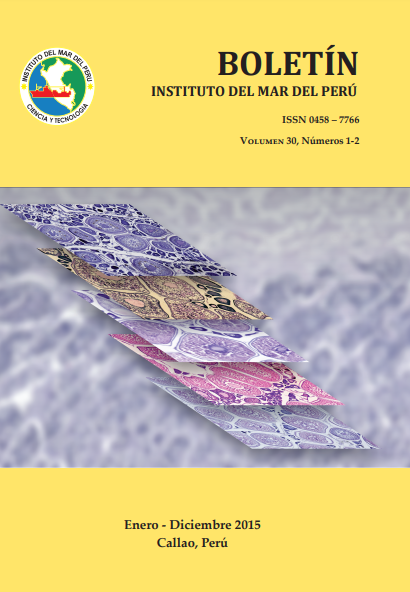
The gonadal maturity scale of long nose anchovy Anchoa nasus is presented. The process of maturation and spawning has been classified into six stages to females and males. Histological sections of 442 individuals collected on board of The R.V. J. Olaya during summer 2008; winter 2009 and spring of 2012 and 2013 were analyzed. We examined the visual and microscopic characteristics that define each stage.
Downloads
Metrics
References
Bouchon M. 2007. Biología y pesquería de samasa (Kner y Steindachner, 1866) (Pisces: Clupeiformes: Engraulidae) en el mar peruano. Tesis para optar el grado de Maestro en Ciencias del mar. Univ. Nac. Federico Villareal. 70 pp.
Bromley PJ. 2003. Progress towards a common gonad grading key for estimating the maturity of North Sea plaice. 2003. En: Report of the working group on Modern approaches to assess maturity and fecundity of warm- and cold- water fish and squids. Bergen (4-7-September 2001):19-24.
Chirichigno N, Cornejo RM. 2001. Catálogo Comentado de los peces marinos del Perú. Publicación Especial Inf. Inst. Mar Perú. 314 pp.
Costa AM. 2009. Macroscopic vs. microscopic identification of the maturity stages of female horse mackerel. – ICES Journal of Marine Science. 66: 509–516.
Ferreri R, Basilone G, D’Elia M, Traina A, SaboridoRey F, Mazzola S. 2009. Validation of macroscopic maturity stages according to microscopic histological examination for European anchovy. Marine Ecology. 30 (1): 181–187.
Gerritsen HD, McGrath D. 2006. Variability in the assignment of maturity stages of plaice (Pleuronectes platessa L.) and whiting (Merlangius merlangus L.) using macroscopic maturity criteria. Fisheries Research. 77: 72–77.
Gonçalves P, Cunha E, Costa A. 2004. Escala de maturação microscópica e macroscópica das gónadas femininas de pescada (Merluccius merluccius). Relat. Cient. Téc. IPIMAR, Série digital (http://ipimariniap. ipimar.pt). 21: 27 pps.
Hunter JR, Goldberg SR. 1980. Spawning indicence and batch fecundity in northern anchovy Encrasicholina purpurea. Fish. Bull. 77(3): 641-652.
Hunter JR, Leong R. 1981. The spawning energetics of female anchovy Engraulis mordax. Fish. Bull. 79(2): 215-230.
Hunter JR, Macewicz BJ. 2003. Improving the accuracy and precision of reproductive information used in fisheries. En: Report of the working group on Modern approaches to assess maturity and fecundity of warmand cold- water fish and squids. Bergen (4-7 September 2001): 57-68.
Maack G, George MR. 1999. Contributions to the reproductive biology of Encrasicholina punctifer Fowler, 1938 (Engraulidae) from West Sumatra, Indonesia. Fisheries Research. 44: 113-120.
Melo CY. 1994. Multiple spawning of the anchovy, Engraulis capensis. S. Afr. J. Mar. Sci. 14: 313-319.
Morgan J. 2008. Integrating reproductive biology into scientific advice for fisheries management J. Northw. Atl. Fish. Sci. 41: 37–51.
Pájaro M, Macchi G, Leonarduzzi E, Hansen JE. 2009. Spawning biomass of Argentine anchovy (Engraulis anchoita) from 1996 to 2004 using the Daily Egg Production Method. Journal of the Marine Biological Association of the United Kingdom. 89(4): 829–837.
PRODUCE. 2012. Anuario Estadístico Pesquero y Acuícola. Ministerio de la Producción. 180 pp.
Saborido-Rey F, Junquera S. 1998. Histological assessment of variations in sexual maturity of cod (Gadus morhua L.) at the Flemish Cap (north-west Atlantic). ICES Journal of Marine Science. 55: 515–521.
Young S, Chiu T. 1994. Ovarian maturation of Japanese anchovy Engraulis japonica T. and S. from I-Lan Bay, Northeastern, Taiwan. Zoological Studies. 33(4): 302-309.
Downloads
Published
How to Cite
Issue
Section
License
Copyright (c) 2015 Instituto del Mar del Perú

This work is licensed under a Creative Commons Attribution 4.0 International License.
© Bol Inst Mar Perú. La revista retiene los derechos patrimoniales de los autores con la finalidad de garantizar el acceso abierto de los manuscritos.
Todos los manuscritos publicados en la revista se distribuyen bajo la licencia “Creative Commons Atribución - NoComercial - CompartirIgual 4.0 Internacional” (CC BY-NC-SA 4.0). Implica que autores y lectores pueden de forma gratuita descargar, almacenar, copiar, redistribuir, remezclar, transformar o generar obras derivadas a partir del manuscrito, siempre y cuando mencionen la fuente primaria de publicación y la autoría del manuscrito, así como que se realice sin fines comerciales y se distribuya bajo la misma licencia que el original. Puede consultar desde aquí la versión informativa y el texto legal de la licencia.


