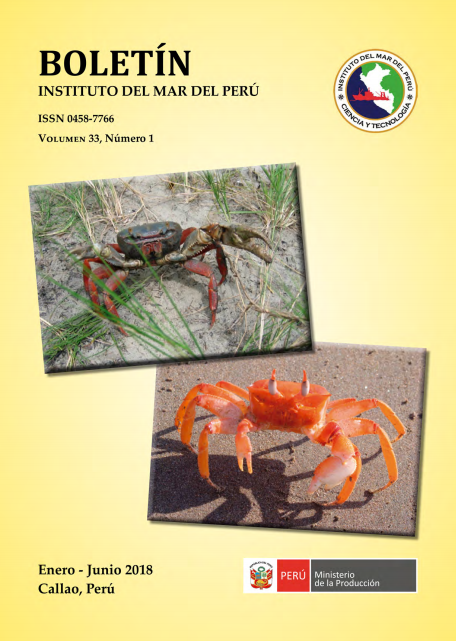
Indirect method for the assessment of population and size distributions and activity pattern of the ghost crab Ocypode gaudichaudii (Crustacea, Decapoda, Ocypodidae) in Tacna, 2010 - 2013
Keywords:
Ocypodegaudichaudii, activity pattern, variogram, spatial dispersionAbstract
In this paper, the spatial distribution and activity pattern of Ocypode gaudichaudii is analyzed by means of an indirect method through the count of the number of burrows, diameter, depth and distances between random points and burrows in order to determine different types of spatial dispersion and measure the state of the intertidal environments of sandy substrate. In the field, at least 2 grids of 20 m2 (20x10 m) were established and grilled every 4 m2 (2x2 m) which were distributed between the dune and undertow zones. In each grid, 15 quadrants (c) and 15 vertex (v) were selected at random and the dispersion index (IBR) of Byth-Ripley was estimated, based on the calculation of distances for independent samples. In the 2010-2013 period, 96 sampling stations were carried out that allowed us to perform 729 similar spatial distribution simulations (grouped, uniform and random), and dispersion variograms were constructed based on density and burrow distribution. A comparison was made between beaches according to the dispersion values that reflected the same trend between the simulated distribution and the observed distribution in the field. The Byth-Ripley index was efficient to differentiate the spatial distribution types described. The variograms allowed to analyze the distribution of the variables and determine the spatial behavior of O. gaudichaudii. The distribution of the species was of the uniform type in both beaches, except in summer when it was random for Santa Rosa (occupying any available space) and grouped for Rancho Chico (in response to possible anthropic or environmental impacts). The periods of maximum activity were distributed between 5 and 10 am and between 5 and 8 pm, especially for adult specimens, and between periods for juvenile specimens.
Downloads
Metrics
References
Alberto R M F, Fontoura N F. 1999. Age structure spatial distribution of Ocypode quadrata (Fabricius, 1787) on a sandy beach from the South Coast of Brazil (Crustacean, Decapoda, Ocypodidae). Revista Brasileira de Biología. 59(1): 95-421.
Araujo C C V, Rosal D M, Fernandes J M. 2008. Densidade e distribuição espacial do caranguejo Ocypode quadrata (Fabricius, 1787) (Crustacea, Ocypodidae) em três praias arenosas do Espírito Santo, Brasil. Biotemas. 21: 73-80.
Barros F. 2001. Ghost crabs as a tool for rapid assessment of human impacts on exposed sandy beaches. Biol. Conservat. 97: 399-404.
Blankensteyn A. 2006. O uso do caranguejo maria-farinha Ocypode quadrata (Fabricius, 1787) (Crustacea, Ocypodidae) como indicador de impactos antropogênicos em praias arenosas da Ilha de Santa Catarina. Revista Brasileira de Zoologia. 23: 870-876.
Brazeiro A, Defeo O. 1999. Effects of harvesting and density dependence on the demography of sandy beach populations: the yellow clam Mesodesma mactroides of Uruguay. Marine Ecology Progress Series. 182: 127-135.
Byth K, Ripley B D. 1980. On sampling spatial patterns by distance methods. Biometrics. 36(2): 279-284.
Clarke M, Peña R. 1988. Zonación de la macroinfauna en una playa de arena del norte de Chile. Estud. Oceanol. 7: 17-31.
Crane J. 1941. On the growth and ecology of brachyuran crabs of the genus Ocypode. Zoologica. 26: 297-310.
Defeo O, de Álava A. 1995. Effects of human activities on long-term trends in sandy beach populations: the wedge clam Donax hanleyanus in Uruguay. Mar. Ecol. Prog. Ser. 123: 73-82.
Defeo O, McLachlan A. 2005. Patterns, processes and regulatory mechanisms in sandy beach macrofauna: a multi-scale analysis. Mar. Ecol. Prog. Ser. 295: 1-20.
Defeo O, McLachlan A. 2011. Coupling between macrofauna community structure and beach type: a deconstructive meta-analysis. Mar. Ecol. Prog. Ser. 433: 29-41.
Fisher J B, Tevesz M J S. 1979. Within-habitat patterns of Ocypode quadrata (Fabricius, 1787) (Decapoda Brachyura). Crustaceana. 5: 31-36.
Hubbard D M, Dugan J E, Schooler N K, Viola S N. 2014. Local extirpations and regional declines of endemic upper beach invertebrates in southern California. Estuarine, Coastal and Shelf Science. 150: 67-75.
Jaramillo E. 1987. Sandy beach macroinfauna from the Chilean coast: zonation patterns and zoogeography. Vie Milieu. 37:165-174.
Jaramillo E, Contreras H, Quijon P. 1996. Macroinfauna and human disturbance in Chile. Revista Chilena de Historia Natural. 69: 655-663.
Magalhães W F, Lima J B, Barros F, Dominguez J M L. 2009. Is Ocypode quadrata (Fabricius, 1787) a useful tool for exposed sandy beaches management in Bahia state (Northeast Brazil)? Brazilian Journal of Oceanography. 57: 149-152.
Masselink G, Short A D. 1993. The Effect of Tide Range on Beach Morphodynamics and Morphology: A Conceptual Beach Model. Jour. of Coastal Res. 9 – 3: 785-800.
Nel R, Campbell E E, Harris L, Hauser L, Schoeman D S, McLachlan A, du Preez D R, Bezuidenhout K, Schlacher T A. 2014. The status of sandy beach science: Past trends, progress, and possible futures. Estuarine, Coastal and Shelf Science. 150: 1-10.
Neves F M, C.E. Bemvenuti C E. 2006. The ghost crab Ocypode quadrata (Fabricius, 1787) as a potential indicator of anthropic impact along the Rio Grande do Sul coast, Brazil. Biological Conservation. 133: 431-435.
Ocaña F A, de Jesús Navarrete A, de Jesús Navarrete R M, Rivera J J O. 2016. Efectos del disturbio humano sobre la dinámica poblacional de Ocypode quadrata (Decapoda: Ocypodidae) en playas del Caribe mexicano. Revista de Biología Tropical/International Journal of Tropical Biology and Conservation. 64(4).
Penttinen A, Stoyand D, Henttonen H. 1992. Marked point processes in forest statistics. Forest Science. 38 (4): 806-824.
Pielou E. 1977. Mathematical Ecology. John Wiley & Sons, Inc. 386 pp.
Ruppert E E, Fox R S. 1988. Animales de la orilla del mar al sureste – en Guía de común invertebrados de aguas someras de la costa atlántica del sudeste. Universidad del Sur de Carolina Press. Columbia, Carolina del Sur. 429 pp.
Scapini F. 2014. Behaviour of mobile macrofauna is a key factor in beach ecology as response to rapid environmental changes. Estuarine, Coastal and Shelf Science. 150: 36-44.
Schlacher T A, Thompson L, Price S. 2007. Vehicles versus conservation of invertebrates on sandy beaches: mortalities inflicted by off-road vehicles on ghost crabs. Marine Ecology. 28: 354-367.
Souza J R B, Lavoie N, Bonifácio P H, Rocha C M C. 2008. Distribution of Ocypode quadrata (Fabricius, 1787) on sandy beaches of Northeastern Brazil. Atlântica. 30: 139-145.
Steiner A J, Leatherman S P. 1981. Recreational impacts on the distribution of ghost crab Ocypode quadrata Fab. Biological Conservation. 20: 111-122.
Strachan P H, Smith R C, Hamilton D A B, Taylor A C y Atkinson R J A. 1999. Studies on the ecology and behaviour of the ghost crab, Ocypode cursor (L) in northern Cyprus. Scientia Marina. 63(1): 51-60.
Wolcott T G, Wolcott D L. 1984. Impact of off-road vehicles on macroinvertebrates of a mid-Atlantic beach. Biol. Conserv. 29: 217-240.
Wolcott T G. 1978. Ecological role of ghost crabs, Ocypode quadrata (Fab.) on an ocean beach: scavengers or predators? Journal of Experimental Marine Biology and Ecology. 31: 67-82.
WoRMS Editorial Board. 2018. World Register of Marine Species. Available from. http://www.marinespecies.org
Downloads
Published
How to Cite
Issue
Section
License
Copyright (c) 2018 Instituto del Mar del Perú

This work is licensed under a Creative Commons Attribution 4.0 International License.
© Bol Inst Mar Perú. La revista retiene los derechos patrimoniales de los autores con la finalidad de garantizar el acceso abierto de los manuscritos.
Todos los manuscritos publicados en la revista se distribuyen bajo la licencia “Creative Commons Atribución - NoComercial - CompartirIgual 4.0 Internacional” (CC BY-NC-SA 4.0). Implica que autores y lectores pueden de forma gratuita descargar, almacenar, copiar, redistribuir, remezclar, transformar o generar obras derivadas a partir del manuscrito, siempre y cuando mencionen la fuente primaria de publicación y la autoría del manuscrito, así como que se realice sin fines comerciales y se distribuya bajo la misma licencia que el original. Puede consultar desde aquí la versión informativa y el texto legal de la licencia.


