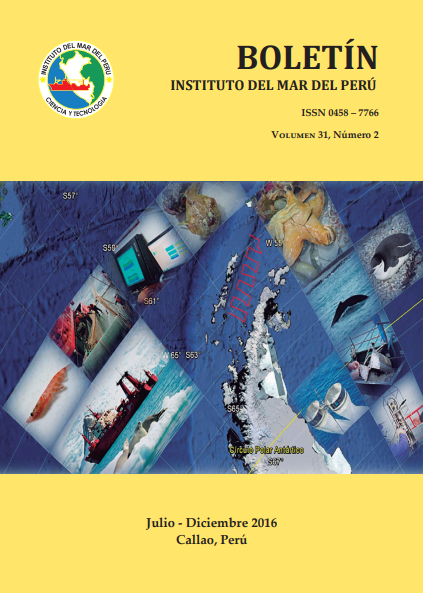
Antarctic seabirds and its relationship with krill (Euphausia superba). ANTAR XXI
Keywords:
Seabirds, Euphausia superba, abundanceAbstract
Seabird observations were made simultaneusly during the 3 main experiments carried out by the scientific mission ANTAR XXI: i) krill’s swarms behaviour experiment, ii) demersal cruise and iii) pelagic cruise assessment of krill in the area between Bransfield Strait and the south of Elephant island. 508 individuals from 17 species and 5 families were recorded. The chinstrap penguin (Pygoscelis antarctica 25.54%), the wilson storm petrel (Oceanites oceanicus 23.18%), the southern giant petrel (Macronectes giganteus 8.45%) and brown skua (Catharacta antarctica 8.45%) accounted for 65.62% of the observations. High correlation between the abundance of krill and southern giant petrel was observed on a small scale; but not observed the same pattern when assessing the abundance of krill with the total abundance of seabirds. During the krill’s swarms behaviour experiment was found there is a correlation between the depth of krill swarms and penguin chinstrap abundance.
Downloads
Metrics
References
Cairns D K. 1987. Seabirds as indicators of marine food supplies. Biol. Oceanogr. 5:.261–271.
Croxall J, Reid K, Prince P. 1999. Diet, provisioning and productivity responses of marine predators to differences in availability of Antarctic krill. Marine Ecology Progress Series, 177: 115-131.
Furness R.W, Camphuysen C.J. 1997. Seabirds as monitors of the marine environment. ICES J Mar Sci. 54: 726–737.
Harrison P. 1987. Seabirds of the world. A photographic guide. Christopher Helm (Ed.). London. 448 pp.
Hatch S A, Sanger G A. 1992. Puffins as samplers of juvenile pollock and other forage fish in the Gulf of Alaska. Mar. Ecol. Prog. Ser. 80: 1–14.
Lishman G S. 1985. The food and feeding ecology of Adélie penguins (Pygoscelis adeliae) and Chinstrap penguins (P. antarctica) at Signy Island, South Orkney Islands. Journal of Zoology 205: 245-263.
Millar A K, Trivelpiece W Z. 2008. Chinstrap penguins alter foraging and diving behavior in response to the size of their principle prey, Antarctic krill. Marine Biology, 154:201-208.
Montevecchi W A. 1993. Birds as indicators of change in marine prey stocks. In: Furness RW, Greenwood DJ (eds) Birds as monitors of environmental change. Chapman & Hall, London, pp 217–266.
Montevecchi W A, Myers R A. 1997. Centurial and decadal oceanographic influences on changes in northern gannet populations and diets in the north-west Atlantic: implications for climate change. ICES J Mar. Sci. 54: 608–614.
Piatt J F, Sydeman W J, Wiese F. 2007. Introduction: A modern role for seabirds as indicators. Marine Ecology Progress Series. 352: 199-204.
Downloads
Published
How to Cite
Issue
Section
License
Copyright (c) 2016 Instituto del Mar del Perú

This work is licensed under a Creative Commons Attribution 4.0 International License.
© Bol Inst Mar Perú. La revista retiene los derechos patrimoniales de los autores con la finalidad de garantizar el acceso abierto de los manuscritos.
Todos los manuscritos publicados en la revista se distribuyen bajo la licencia “Creative Commons Atribución - NoComercial - CompartirIgual 4.0 Internacional” (CC BY-NC-SA 4.0). Implica que autores y lectores pueden de forma gratuita descargar, almacenar, copiar, redistribuir, remezclar, transformar o generar obras derivadas a partir del manuscrito, siempre y cuando mencionen la fuente primaria de publicación y la autoría del manuscrito, así como que se realice sin fines comerciales y se distribuya bajo la misma licencia que el original. Puede consultar desde aquí la versión informativa y el texto legal de la licencia.


