Antarctic marine birds and mammals related krill Euphausia superba in Bransfield Strait and Elephant Island
Keywords:
Marine birds, Euphausia superba, krill, marine mammals, AntarcticAbstract
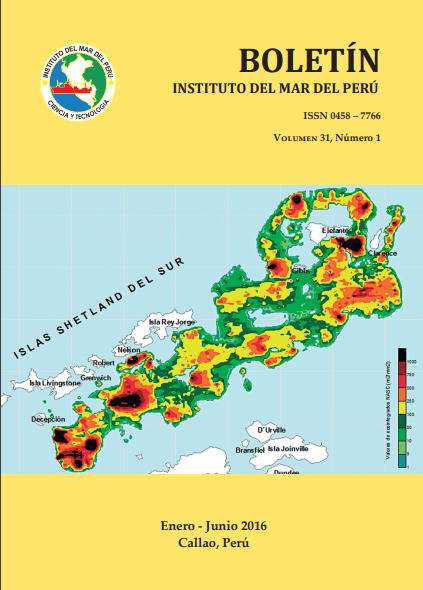
We describe the distribution and diversity of Antarctic marine mammals and seabirds based on the observations made during the XVII Peruvian Expedition to the Antarctica (ANTAR XVII). The observations were made aboard the BIC Humboldt from 17th to 23rd January 2007. The observation effort was 718 and 470 nm for birds and mammals, respectively; from a total distance of 1078 nm. We analyzes the relationship between the composition and abundance of species and the spatial units of observation (transects) defined from the total track. A total of 16 species of seabirds and 5 of marine mammals were observed. The most abundant bird species were: Pygoscelis antartica, Fulmarus glacialoides, Daption capensis and Oceanites oceanicus, and for mammals: Megaptera novaeangliae and Orcinus orca. The niche breadth indices let us describe two groups in the species and families distribution: those associated with inshore (narrow niche) and those associated with both inshore and offshore (broad niche). Hierarchical clustering analysis of the units (transects) defined mainly two types of areas, characterized by their association to the coastline; and the species diversity indices identified significant spatial units both associated and non-associated to coast.
Downloads
Metrics
References
Aguayo A, Torres D, Acevedo J. 1998. Los mamíferos marinos de Chile: I. Cetácea. Serie Científica INACH 48:19-159.
Balance L T, Ainley D G, Hunt G L. Jr. 2001. Seabird Foraging Ecology. Pages 2636-2644 En: Encyclopedia of Ocean Sciences, vol. 5. Editado por: J. H. Steele, S. A. Thorpe y K. K. Turekian. Academic Press, London.
Berta A, Sumich J, Kovacs K. 2006. Marine Mammals. Evolutionary Biology. Elsevier, Segunda Edición. 547 pág.
Buccicardi U, Takahashi D. 2004. Mamíferos antárticos en el Estrecho de Bransfield y alrededores de Isla Elefante. Verano austral 2003. Informe Instituto del Mar del Perú 32(4): 373-379.
Furness R W, Monaghan P. 1987. Seabird Ecology. Blackie. London. 164 pag.
Gibbons D W, Hill D, Sutherland W J. 1996. En: Ecological Census Techniques: A Handbook. Editado por: Sutherland, W. J. Cambridge University Press.
Hammer Ø, Harper D A T, Ryan P D. 2001. PAST. Palaeontological Statistic software package for education and data analysis. Palaeontologia Electronica 4(1):9 pag.
Hastie G, Wilson B, Wilson L, Parsons K, Thompson P. 2004. Functional mechanisms underlying cetacean distribution patterns: hotspots for bottlenose dolphins are linked to foraging. Marine Biology 144: 397-403.
Krebs C J. 1989. Ecological Methodology. Harper & Row, New York.
Magurran A E. 1988. Diversidad ecológica y su medición. Ediciones Vedra. Barcelona.
Obst B S. 1985. Densities of Antarctic seabirds at sea and the presence of the krill Euphausia superba. The Auk 102: 540-549.
Ontón K, Vega D, Arias-Schreiber M. 1999. Distribución e índices de avistamientos de mamíferos marinos y su relación con la abundancia del krill Euphausia superba. Perú ANTAR IX. Informe Instituto del Mar del Perú (145): 63-68.
Reid T A, Hull C L, Eades D W, Scofield R P, Woehler E J. 1999. Shipboard observations of penguins at sea in the Australian Sector of the Southern Ocean, 1991-1995. Marine Ornithology 27: 101-110.
Sutherland W J. 1996. En: Ecological Census Techniques: A Handbook. Editado por: Sutherland, W. J. Cambridge University Press.
Trites A. 1997. The role of pinnipeds in the ecosystem. En: Pinniped populations, Eastern North Pacific: status and issues. Editado por: G. Stone, J. Goebel y S. Webster.
Trivelpiece W Z, Trivelpiece S G, Volkman N J. 1987. Ecological segregation of Adelie, gentoo and chinstrap penguins at King George Island, Antarctica. Ecology. 68(2):351-361.
Woehler E J. 1993. The Distribution and Abundance of Antarctic and Sub Antarctic Penguins. Scientific Committee on Antarctic Research, Cambridge, England.
Downloads
Published
How to Cite
Issue
Section
License
Copyright (c) 2016 Instituto del Mar del Perú

This work is licensed under a Creative Commons Attribution 4.0 International License.
© Bol Inst Mar Perú. La revista retiene los derechos patrimoniales de los autores con la finalidad de garantizar el acceso abierto de los manuscritos.
Todos los manuscritos publicados en la revista se distribuyen bajo la licencia “Creative Commons Atribución - NoComercial - CompartirIgual 4.0 Internacional” (CC BY-NC-SA 4.0). Implica que autores y lectores pueden de forma gratuita descargar, almacenar, copiar, redistribuir, remezclar, transformar o generar obras derivadas a partir del manuscrito, siempre y cuando mencionen la fuente primaria de publicación y la autoría del manuscrito, así como que se realice sin fines comerciales y se distribuya bajo la misma licencia que el original. Puede consultar desde aquí la versión informativa y el texto legal de la licencia.


