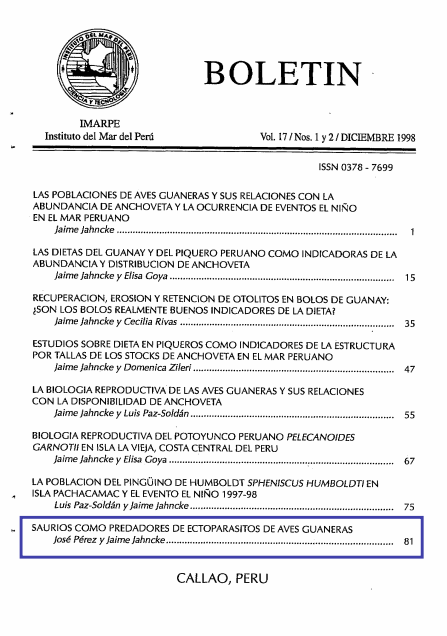
Breeding biology of the Peruvian Diving-Petrel Pelecanoides garnotii on La Vieja Island, central coast of Peru
Keywords:
Peruvian Diving-petrel, Pelecanoides gamotii, breeding biology, growth ratesAbstract
Breeding adults were found all around the year; however two peaks were identified. The first and most noticeable, occurs during the summer from December through March. The second, occurs in winter from May through September. Incubation period was estimated to last 50 to 60 days. Rearing period takes 70 to 80 days for complete development. Higher growth rates were found during winter, probably due to a better quality of food. In winter Peruvian Diving-petrels feed mostly on fish larvae, while in summer they feed mostly on planktonic crustaceans. During the El Niño event 1997-98, the first breeding peak occurred normally. Variations were noticed during the second peak. The proportion of incubating adults dropped from 45,25% in May to 17,5% in July. The proportion of nests with chicks dropped from 15% in May and July to less than 5% in September. All this suggests a low hatching success and a high chick mortality. A census conducted during November of 1997 showed a population of 12.800 pairs of birds and does not differ from censuses conducted before. Incubating adults were found in at least 38,41% of the surveyed nests, 66.27% of them were previously banded birds.
Downloads
Metrics
References
COKER, R. 1919. Habitats and economics relations of guano birds of Perú. Proc. U. S. Nat. Mus. 36: 449-511.
DUFFY, D. C., C. HAYS y M. A. PLENGE. 1984. The conservation status of peruvian seabirds. p: 245-259. En: CROXALL, J.P, P.G.H. EVANS y R.W. SCHREIBER (Eds.). Conservation of the world's seabirds. Cambridge, UK.: ICBP (Tech. Publ. 2).
FURNESS, R. W. y P. MONAGHAN. 1987. Seabird Ecology. Blackie and Son Ltd. Glasgow and London. 164 pp.
GINN, H. B. y D. S. MELVILLE. 1983. Moult in birds. BТО Guide N°19. The British trust for ornithology. Tring. England. 112 pp.
HAYS, C. 1989. The Peruvian Diving-petrel in Perú. Oryx 23(2): 102-105.
JAHNCKE, J. y E. GOYA. 1998. The status of the Peruvian Diving-petrel population at its main breeding areas along the coast of Peru. Colonial Waterbirds 21: 94-97.
JAHNCKE, J. y E. GOYA. The diet of the Peruvian Divingpetrel at La Vieja and San Gallán, Perú. J. Field Onithol. 70. (en prensa).
MURPHY, R. C. 1936. Oceanic birds of South America. The Mc Millan Company, New York. 1245 pp.
RICKLEFS, R. 1967. A graphical method of fitting equations to growth curves. Ecology 48(6): 978-983.
RICKLEFS, R. E. 1975. A method for constructing nesting growth curves from brief visits to seabird colonies. BirdBanding 46: 135-140.
RIVEROS, J. C. y J. JAHNCKE. 1990. The Peruvian Divingpetrel Pelecanoides garnotii in Peru. Pacific Seabird Group Bull. 17: 32-33.
SEDINGER, J. S. 1986. Growth and development of Canada goose goslings. The Condor 88: 169-180.
TOVAR, H. 1978. Avifauna marina en islas del sur peruano. Documenta VI, 64: 40-45.
VAN HEEZIK, Ү. M. 1991. A comparasion of yellow-eyed penguin growth rates across fithy years: Richdale revisited. Notornis 38: 117-123.
WARHAM, J. 1990. The petrels; Their ecology and breeding systems. Academic press. London. 440 pp.
Downloads
Published
How to Cite
Issue
Section
License
Copyright (c) 1998 Instituto del Mar del Perú

This work is licensed under a Creative Commons Attribution 4.0 International License.
© Bol Inst Mar Perú. La revista retiene los derechos patrimoniales de los autores con la finalidad de garantizar el acceso abierto de los manuscritos.
Todos los manuscritos publicados en la revista se distribuyen bajo la licencia “Creative Commons Atribución - NoComercial - CompartirIgual 4.0 Internacional” (CC BY-NC-SA 4.0). Implica que autores y lectores pueden de forma gratuita descargar, almacenar, copiar, redistribuir, remezclar, transformar o generar obras derivadas a partir del manuscrito, siempre y cuando mencionen la fuente primaria de publicación y la autoría del manuscrito, así como que se realice sin fines comerciales y se distribuya bajo la misma licencia que el original. Puede consultar desde aquí la versión informativa y el texto legal de la licencia.


