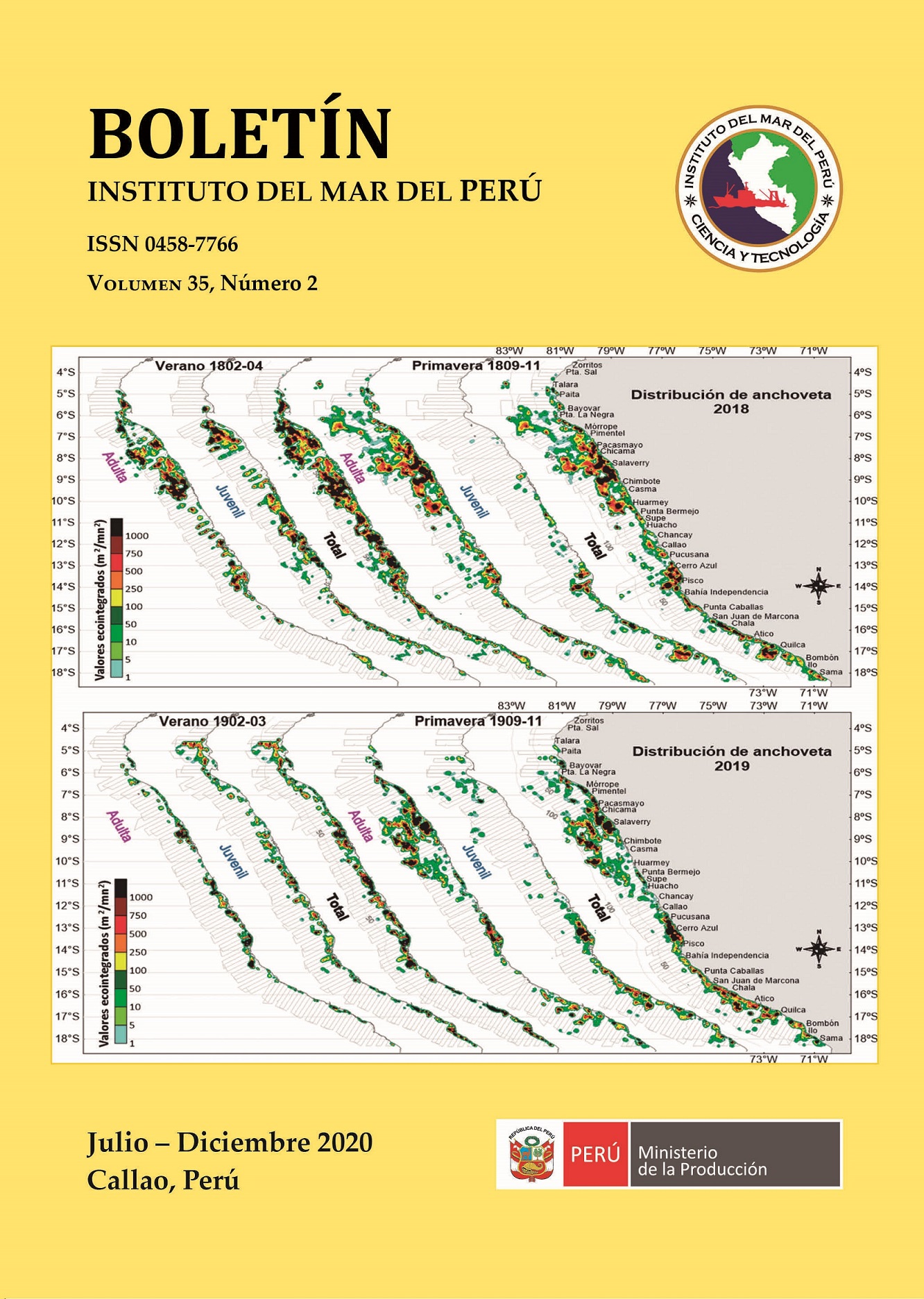
Distribution and biomass of the main pelagic, neritic, and oceanic resources in the Peruvian marine ecosystem obtained through hydroacoustic cruises (2018)
Keywords:
Pelagic neritic and oceanic resources, hydroacoustic assessment, distribution by concentration levels, stratification in isoparalittoral areasAbstract
The year 2018 was characterized by environmental oceanographic contrasts in the Peruvian marine ecosystem. We carried out two hydroacoustic cruises, one in the summer, between February 22 and April 6 (Cr. 1802-04), and the other in the spring, between September 27 and November 18 (Cr. 1809-11), onboard the research vessels of the Instituto del Mar del Perú. Both cruises had the support of fishing vessels from the Sociedad Nacional de Pesquería (National Fisheries Society), to increase biological and acoustic sampling. In the neritic zone, the abundant species were anchoveta, longnose anchovy, catfish, and munida lobster, while the jumbo flying squid and vinciguerria were abundant in the pelagic oceanic zone. In 2018, the anchoveta was distributed widely with biomasses of 11.21 million tons in summer and 8.78 million tons in spring. The munida lobster showed high biomass with 4.97 million tons in the summer due to the cold conditions recorded in that period; while vinciguerria was more abundant in the spring with 2.08 million tons, mainly in the south since the oceanic waters were closer to the coast. The highest biomass of jack mackerel was estimated in the spring at 263,779 tons, the abundance of jack mackerel and chub mackerel was not stable due to oceanographic conditions. Longnose anchovy and catfish are coastal species, their highest abundances were recorded in summer with 241,213 tons and 46,717 tons, respectively. For anchoveta, more schools were recorded in spring than in summer, with higher coefficients of variation in morphometric characteristics; while, in summer, they had higher energetic characteristics due to the concentration of schools.
Downloads
Metrics
References
Bakun A, Weeks S J. 2008. The marine ecosystem off Peru: What are the secrets of its fishery productivity and what might its future hold? Progress in Oceanography. 79: 290 – 299. Doi 10.1016/j.pocean.2008.10.027
Bertrand A, Gerlotto F, Bertrand S, Gutiérrez M, Alza L, Chipollini A, Díaz E, Espinoza P, Ledesma L, Quesquén R, Peraltilla S, Chavez F. 2008. Schooling behaviour and environmental forcing in relation to anchoveta distribution: an analysis across multiple spatial scales. Progress in Oceanography. 79: 264-277.
Castillo R, Gutierrez M, Peraltilla S, Herrera N. 1998. Biomasa de recursos pesqueros a finales del invierno 1998. Crucero BIC Humboldt y BIC José Olaya Balandra 9808-09, de Paita a Tacna. Inf Inst Mar Perú. 141: 136-155.
Castillo R, Dalla Rosa L, García Díaz W, et al. 2018. Anchovy distribution off Peru in relation to abiotic parameters: A 32-year time series from 1985 to 2017. Fish Oceanogr. 1–13. doi.org/10.1111/fog.12419.
Castillo P R, Peraltilla S, Aliaga A, Flores M, Ballon M, Calderón J, Gutiérrez M. 2011. Protocolo técnico para la evaluación acústica de las áreas de distribución y abundancia de recursos pelágicos en el mar peruano. Versión 2009. Instituto del Mar del Perú. 36(1-2): pp. 7-28.
Chavez F, Bertrand A, Guevara-Carrasco R, Soler P, Csirke J. 2008. The northern Humboldt Current System: brief history, present status and a view towards the future. Prog. Oceanogr. 79: 95–105.
Chavez F, Barber R T, Sanderson M P. 1989. The potential Primary Production of the Peruvian Upwelling System. Instituto del Mar del Peru (IMARPE), Deutsche Gesellschaft fur Technische Zusammenarbeit (GTZ) and International Center for Living Aquatic Resources Management (ICLARM).
Demer D A, Berger L, Bernasconi M, Bethke E, Boswell K, Chu D, Domokos R, et al. 2015. Calibration of acoustic instruments. ICES Cooperative Research Report No. 326: 133. Doi: http://dx.doi.org/10.25607/OBP-185
ENFEN. 2018a. Comunicado Oficial de la Comisión Multisectorial Estudio Nacional del Fenómeno El Niño, Nro. 01.
ENFEN. 2018b. Comunicado Oficial de la Comisión Multisectorial Estudio Nacional del Fenómeno El Niño, Nro. 05.
ENFEN. 2018c. Comunicado Oficial de la Comisión Multisectorial Estudio Nacional del Fenómeno El Niño. Nro. 08
ENFEN. 2018d. Comunicado Oficial de la Comisión Multisectorial Estudio Nacional del Fenómeno El Niño. Nro. 09.
Flores R, Espino M, Luque G, Quispe J. 2013. Patrones de variabilidad ambiental en el mar peruano. En: Csirke J., R. Guevara-Carrasco & M. Espino (Eds.). Ecología, pesquería y conservación del jurel (Trachurus murphyi) en el Perú. Rev. Peru. biol. número especial 20(1): 21 – 28.
Graco M, Ledesma J, Flores G, Girón M. 2007. Nutrientes, oxígeno y procesos biogeoquímicos en el sistema de surgencias de la corriente de Humboldt frente a Perú. Revista Peruana de Biología 14(1): 117 – 128.
Gutiérrez M. 1999a. Mediciones in situ de TS a finales de la primavera 1998. Crucero BIC José Olaya Balandra 9811-12. Inf Inst Mar Perú. 146: 7-10.
Gutiérrez M. 1999. Mediciones in situ de TS a finales del verano 1999. Crucero BIC José Olaya Balandra 9902-03. Inf Inst Mar Perú. 147: 7-10.
Gutiérrez M, Herrera N. 1998. Mediciones de TS in situ de diversas especies a finales del invierno de 1998. Crucero BIC José Olaya Balandra 9808-09. Inf Inst Mar Perú. 141: 7-12.
Gutiérrez M, MacLennan D. 1998. Resultados preliminares de las mediciones de fuerza de blanco in situ de las principales especies pelágicas. Inf Inst Mar Perú. 135: 16-19.
Hastie T, Tibshirani R. 1990. Generalized Additive Models. Chapman and Hall, London. 335 pp.
IMARPE. 2017a. Informe sobre el Proceso Reproductivo de Anchoveta del stock Norte-Centro del Perú al 20 de enero de 2018. Inf Inst Mar Perú. 4 pp.
IMARPE. 2018a. Informe Ejecutivo del Crucero de Evaluación Hidroacústica de Recursos Pelágicos 1802-04. Inf Inst Mar Perú. 52 pp.
IMARPE. 2018b. Informe de la primera temporada de pesca de anchoveta en la región norte-centro del mar peruano (07 abril-30 julio 2018). Inf Inst Mar Perú. 12 pp.
IMARPE. 2018c. Informe Ejecutivo del Crucero de Evaluación Hidroacústica de Recursos Pelágicos 1809-11. Inf Inst Mar Perú. 57 pp.
IMARPE. 2018d. Informe de la Situación del stock norte-centro de la anchoveta peruana (Engraulisringens) al 10 de noviembre del 2018 y perspectivas de explotación para la segunda temporada de pesca de 2018. Inf Inst Mar Perú. 18 pp.
INEI. 2019. Informe técnico Comportamiento de la Economía Peruana en el Cuarto Trimestre de 2018. Producto Bruto Interno Trimestral. Instituto Nacional de Estadística e Informática. 56 pp.
MacLennan D N, Gutiérrez M, Castillo R, Ganoza F, Escudero L, Gonzales A, Chalén X, Aliaga A. 1998. Fuerza de Blanco de anchoveta (Engraulis ringens) utilizando frecuencias de 38 y 120 kHz. Inf Inst Mar Perú. 133: 15-25.
McCALL A D. 1990. Dynamic Geography of Marine Fish Populations: Books in Recruitment Fishery Oceanography. University of Washington. 163 pp.
Morón O. 2000. Características del ambiente marino frente a la costa peruana. Bol Inst Mar Perú. 19: 179–204.
Murase H, Nagashima H, Yonezaki S, Matsukura R, Kitakado T. 2009. Application of a generalized additive model (GAM) to reveal relationships between environmental factors and distributions of pelagic fish and krill: a case study in Sendai Bay, Japan. ICES Journal of Marine Science. 66: 1417–1424.
Simmonds J, MacLennan D. 2005. Fisheries Acoustics. Theory and Practice. Second edition published by Blackwell Science. 436 pp.
Downloads
Published
How to Cite
Issue
Section
License

This work is licensed under a Creative Commons Attribution 4.0 International License.
© Bol Inst Mar Perú. La revista retiene los derechos patrimoniales de los autores con la finalidad de garantizar el acceso abierto de los manuscritos.
Todos los manuscritos publicados en la revista se distribuyen bajo la licencia “Creative Commons Atribución - NoComercial - CompartirIgual 4.0 Internacional” (CC BY-NC-SA 4.0). Implica que autores y lectores pueden de forma gratuita descargar, almacenar, copiar, redistribuir, remezclar, transformar o generar obras derivadas a partir del manuscrito, siempre y cuando mencionen la fuente primaria de publicación y la autoría del manuscrito, así como que se realice sin fines comerciales y se distribuya bajo la misma licencia que el original. Puede consultar desde aquí la versión informativa y el texto legal de la licencia.


