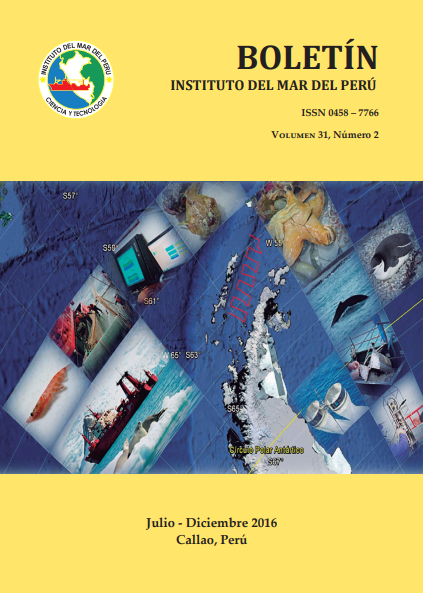
Bioacoustic study of krill (Euphausia superba) in the Bransfield Strait, Antartica
Keywords:
Bioacoustics, Euphausia superba, AntarticaAbstract
Hydroacoustic evaluation of the distribution and biomass of krill (E. superba) was held on board the BIC Humboldt, in February 2013. The area evaluated between the Bransfield Strait and near the Gibbs Island totaling 11,712 nm2. During the day, krill swarms were record at high densities between 20 and 50 m deep, during the night dispersed and scattered swarms were detect from the surface to 20 m deep. The highest densities were observe at the eastern end of Bransfield Strait, followed by a regular distribution between the islands King George and Gibbs with average densities (500-1,000 m/mn²) and high (> 1000 m/mn²). A low density core was observed between Deception and Torre islands. The temperature range of the swarms of krill was between -1.0 and 1.5 °C. Aggregations of krill were observe between 33.96 and 34.35 ups salinity. A hydroacoustic biomass of krill 876.368 t was estimated by Stochastic Distorted Wave Approximation (SDWBA) method.
Downloads
Metrics
References
AMLR 1997/1998. 1998. Field Season Report, objectives, accomplishments and tentative conclusions. Ed. Jane Martin. Southwest Fisheries Science Center. Antartic Ecosystem Research Group, Administrative Report LJ-98-07. 166 pp.
AMLR 2009/2010. 2011. Field Season Report, objectives, accomplishments and tentative conclusions. Ed. Amy Van Cise. Southwest Fisheries Science Center. Antartic Ecosystem Research Division NOAA-TM-NMFS-SWFSC-470, 66 p.
Cossio A M, Reiss C. 2011. Bioacoustics survey. In: AMLR 2009/2010. 2011. Field Season Report, objectives, accomplishments and tentative conclusions. Ed. Amy Van Cise. Southwest Fisheries Science Center. Antartic Ecosystem Research Division NOAA-TM-NMFS-SWFSC-470, 12-16 p.
Demer D A, Hewitt R P. 1995. Bias in acoustic biomass estimates of Euphausia superba due to diel vertical migration. Deep Sea Research 42: 455-475.
Demer D A, Conti S G. 2005. New target-strength model indicates more krill in the Southern Ocean. ICES Jour. Mar. Sci. 62: 25–32.
Foote K G, Knudsen H P, Vestnes D N, MacLennan D N, Simmonds E J. 1987. Calibration of acoustic instruments for fish density estimation: a practical guide. ICES Coop. Res. Rep. 144:1–69.
Greene C H, Stanton T K, Wiebe P H, McClatchie S. 1991. Acoustic estimates of Antarctic krill. Nature, 349: 110.
Greenlaw C, Johnson R. 1983. Multiple frequency acoustical estimation. Biological Oceanography, Vol.2, Number 2, 3-4: 227-252.
Hewitt R P, Watkins M, Naganobu V, Sushin A, Brierley S, Demer D A, Kasatkina S, Takao Y, Goss C, Malyshko A, Brandon M, Kawaguchi S, Siegel V, Trathan P, Emery J, Everson I, Miller D. 2004. Biomass of Antarctic krill in the Scotia Sea in January/February 2000 and its use in revising an estimate of precautionary yield. Deep-Sea Research 2 (51):1215–1236.
Holliday D V. 1977. Extracting biophysical information from acoustic signatures of marine organisms. Oceanic Sound Scattering Prediction. Edited by N. Andersen and B. Zahuraneo, Plenum Press: 619-624.
Jolly G M, Hampton I. 1990. A stratified random transect design for acoustic surveys of fish stocks. Canadian Journal of Fisheries and Aquatic Science 47, 1282–1291.
McGehee D, O’Driscoll R, Martin L. 1998. Effects of orientation on acoustic scattering from Antarctic krill at 120 kHz. Deep-Sea Research II 45: J 273-1294
Watkins J L, Brierley A S. 2002. Verification of the acoustic techniques used to identify Antarctic krill. – ICES Journal of Marine Science, 59: 1326–1336.
Downloads
Published
How to Cite
Issue
Section
License
Copyright (c) 2016 Instituto del Mar del Perú

This work is licensed under a Creative Commons Attribution 4.0 International License.
© Bol Inst Mar Perú. La revista retiene los derechos patrimoniales de los autores con la finalidad de garantizar el acceso abierto de los manuscritos.
Todos los manuscritos publicados en la revista se distribuyen bajo la licencia “Creative Commons Atribución - NoComercial - CompartirIgual 4.0 Internacional” (CC BY-NC-SA 4.0). Implica que autores y lectores pueden de forma gratuita descargar, almacenar, copiar, redistribuir, remezclar, transformar o generar obras derivadas a partir del manuscrito, siempre y cuando mencionen la fuente primaria de publicación y la autoría del manuscrito, así como que se realice sin fines comerciales y se distribuya bajo la misma licencia que el original. Puede consultar desde aquí la versión informativa y el texto legal de la licencia.


