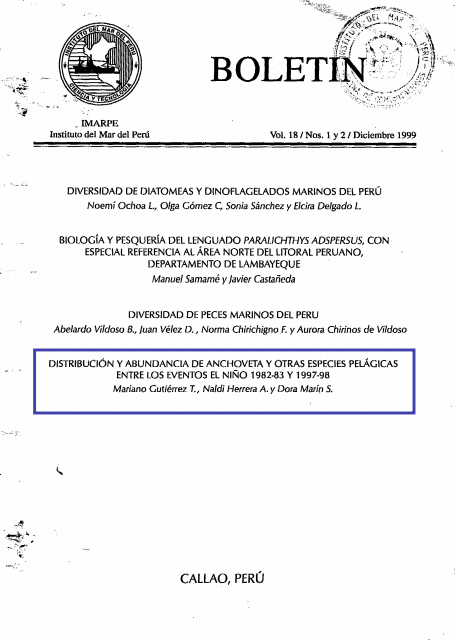
Distribution and abundance of Peruvian anchovy and other pelagic species between El Niño 1982-83 and 1997-98
Keywords:
Peruvian anchovy, Engraulis ringens, El Niño, pelagic resources, Peruvian seaAbstract
Pelagic fishes are the most abundant species in the Southeast Pacific and they sustain one of the more important fisheries in the world, the Peruvian anchovy (Engraulis ringens). During strong El Niño events occurred in the recent decades, abundance of anchovy decayed for several factors; after each event of strong intensity she was replaced in the environment by other resources. During La Niña event the situatiog is inverse, because anchovy is usually the predominant species in abundance due to its quick growth and reproduction and to the biggest availability of food in that period. Generally, abundance of anchovy shows a negative correlation with abundance of other pelagic resources, specialiy Pacific sardine, although we lack of a model that establishes this relationship.
Downloads
Metrics
References
ARNTZ, W., E. FAHRBACH. 1991. El Niño, experimento climático de la naturaleza. FCE, México. 312 pp.
CASTILLO, R., M. GUTIÉRREZ, S. PERALTILLA, N. HERRERA. 1999. Biomasa de recursos pesqueros a finales del invierno de 1998. Crucero BIC Humboldt y BIC Olaya 9808-09. Inf. Inst. Mar Perú 141: 136-155.
FOOTE, K. G. 1983. Linearity of Fisheries Acoustics, with additiom theorems. J. Acoust. Soc. Am., 73, 1932-40.
FOOTE, K. G. 1987. Fish Target Strengths for use in echointegrator surveys. J. Acoust. Soc. Am., 82, 981-87.
GUTIÉRREZ, M. y S, PERALTILLA. 1998. Aplicación de un Sistema de Información Geográfica y de la carta electrónica isoparalitoral en las evaluaciones hidroacústicas de la biomasa de recursos pesqueros en el mar peruano. Inst. Mar Perú 146: 25-29.
GUTIÉRREZ, M. 1997. Aplicación de software de interpolación en la evaluaciones hidroacústicas de la biomasa y distribución de recursos pelágicos. Inf. Prog. Inst. Mar Perú 67: 21-30.
GUTIÉRREZ, M., R. CASTILLO, A. CHIPOLLINI y L. VÁSQUEZ. 1997a. Distribución, concentración y biomasa de los principales recursos pelágicos peruanos entre noviembre y diciembre de 1996. Crucero BIC SNP-1 9611-12. Inf. Prog. Inst. Mar Perú 65: 3-22.
GUTIÉRREZ, M., F. GANOZA, L. PIZARRO y A. ZUZUNAGA. 1997b. Informe Ejecutivo del Crucero Bioceanográfico 9707-08. BIC Humboldt. Informe Interno IMARPE.
JOHANESSON, K. y J. VILCHEZ. 1979. Los resultados de calibración experimental en merluza viva como preparación para la implementación de prospecciones bioacústicas dirigidas a determinar la magnitud de los recursos peruanos de merluza. Report to IMARPE, February 1979.
MACLENAN, D. y J. SIMMONDS. 1992. Fisheries Acoustics. Chapman & Hall Eds. 325 pp.
ÑIQUEN, M. y M. GUTIÉRKEZ. 1998. Variaciones poblacionales y biológicas de los principales recursos pelágicos entre abril de 1997 y abril de 1998 en el mar peruana. En Inf. Inst. Mar Perú 135: 79-90.
Downloads
Published
How to Cite
Issue
Section
License
Copyright (c) 1999 Instituto del Mar del Perú

This work is licensed under a Creative Commons Attribution 4.0 International License.
© Bol Inst Mar Perú. La revista retiene los derechos patrimoniales de los autores con la finalidad de garantizar el acceso abierto de los manuscritos.
Todos los manuscritos publicados en la revista se distribuyen bajo la licencia “Creative Commons Atribución - NoComercial - CompartirIgual 4.0 Internacional” (CC BY-NC-SA 4.0). Implica que autores y lectores pueden de forma gratuita descargar, almacenar, copiar, redistribuir, remezclar, transformar o generar obras derivadas a partir del manuscrito, siempre y cuando mencionen la fuente primaria de publicación y la autoría del manuscrito, así como que se realice sin fines comerciales y se distribuya bajo la misma licencia que el original. Puede consultar desde aquí la versión informativa y el texto legal de la licencia.


