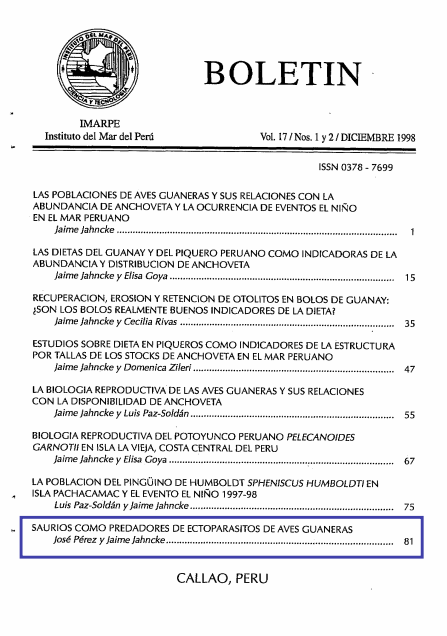
Guanay Cormorant and Peruvian Booby diets as indicators of Peruvian anchovy abundance and distribution
Keywords:
Seabirds, diet, feeding, Leucocarbo (Phalacrocorax) bougainvillii, Sula variegata, Engraulis ringensAbstract
Even though Guanay Cormorants Leucocarbo (Phalacrocorax) bougainvilli and Peruvian Boobies Sula variegata feed on a wide range of fish resources, they show preference for Peruvian Anchovy Engraulis ringens. It has been found that the proportion of anchovy in the regurgitations of both seabird species is strongly correlated to the anchovy biomass (estimated by hydroacustic methods). Latitudinal variations in the proportion of anchovy ingested by Guanay Cormorants reflect anchovy availability along the coast. Peruvian Booby diet hardly show this latitudinal trend probably due to different foraging strategies. Peruvian Boobies have a higher anchovy consumption in summer than in winter. This is probably because anchovies concentrate near the coast during spring and summer, while in winter they scatter and may reach twice the depth. Guanay Cormorants have a slightly higher consumption of anchovy during winter and spring, because they feed on a higher amount of young anchovies. The opportune use of seabird diet monitoring information, collected on islands and capes along the coast, would permit determination of changes in anchovy abundance and distribution periodically and with a low cost. This data may complement acoustic survey estimations and industrial fishery reports on anchovy stocks.
Downloads
Metrics
References
ADAMS, N. J., P. J. SEDDON y Y. M. VAN HEEZIK. 1992. Monitoring of seabirds in the Benguela system: Can seabirds be used as indicators and predictors of change in the marine environment?. S. Afr. J. Mar. Sci. 12: 959-974.
ASHMOLE, M. J. y N. P. ASHMOLE. 1968. The use of food samples from seabirds in the study of seasonal variation in the surface fauna of tropical oceanic areas. Pacific Science 22 (1): 1-10.
AVILA, E. 1954. Potencia deyectiva del guanay Phalacrocorax bougainvillii. Bol. Cia. Admora. Guano 1 (2): 22-49.
BARREDA, M. 1959. Recuperación de guanayes Phalacroсоrax bougainvillii. caquecticos en cautiverio. Estudio de su ingestión y deyección. Bol. Cía. Admora. Guano 35(4): 10-22.
BOERSMA, D. C. 1978. Breeding patterns of Galapagos penguins as an indicator of oceanographic conditions. Science 200: 1481-1483.
CABRERA, D. 1979. Bases para el manejo del recurso aves guaneras en el Perú. Tesis doctoral. Universidad Nacional de Trujillo. 44 p.
CAIRNS, D. K. 1987. Seabirds as indicators of marine food supplies. Biological Oceanography. 5:261-271.
CARDENAS, G., L. ESCUDERO, A. ECHEVARRÍA y J. PELLON. 1997. Distribución, concentración y aspectos biológico pesqueros de los principales recursos pelágicos. Crucero BIC Humboldt 9608-09. Inf. Inst. Mar Perú 123: 28-37.
CHIPOLLINI, A., G. CARDENAS, A. ECHEVERRÍA y M. FLORES. 1997. Aspectos biológico pesqueros de los recursos pelágicos peruanos durante febrero-abril de 1997. Inf. Inst. Mar Perú 127: 1-92.
CRAWFORD, R. J. M. 1987. Food and population variability in five regions supporting large stocks of anchovy, sardine and horse mackerel. En: PAYNE, A. I. L., J. A GULLANID, y K. H. BRINK (Eds.). The Benguela and comparable ecosystems. S. Afr. J. Mar. Sci. 5: 735-757.
CRAWFORD, R. J. M. y B. M. DYER. 1995. Responses by four seabirds to a fluctuating availability of Cape Anchovy Engraulis capensis off South Africa. Ibis 137: 329-339.
CRAWFORD, R. J. M. y P. A. SHELTON. 1978. Pelagic fish and seabirds inter relationships off the coast of South West and South Africa. Biological Conservation 14 (2): 85-109.
CRAWFORD, R. J. M., L. G. UNDERHILL, C. M. RAUBENHEIMER, B. M. DYER y J. MARTIN. 1992. Top predators in the Benguela ecosystem - implications of the trophic position. S. Afr. J. Mar. Sci. 12: 675-687.
DUFFY, D. C., R. P. WILSON, y M. P. WILSON. 1987. Spatial and temporal patterns of diet in the cape cormorant off Southern Africa. The Condor 89: 830-834.
FURNESS, R. W. y P. MONAGHAN. 1987. Seabird ecology.. Blackie and Son Ltd. Glasgow and London. 164 pp.
GALARZA, N. 1968. Informe sobre los estudios ornitológicos realizados en el laboratorio de la Puntilla (Pisco) en setiembre de 1965/66. Ser. Inf. Esp. Inst. Mar Perú 31: 1-20.
GAMARRA, L. 1941. Relación de cantidad de alimento ingerido por las aves guaneras y el guano aprovechable que producen. Bol. Cía. Admora. Guano 17 (3): 103-116.
GUTIÉRREZ, M., O. MORON y A. ECHEVARRÍA. 1997. Distribución, concentración y biomasa de los principales recursos pelágicos peruanos a inicios del otoño de 1997. Crucero BIC SNP-1 9702-03 y BIC Humboldt 9704, Callao-Paita. Inf. Inst. Mar Perú 127: 13-23.
GUTIÉRREZ, M., R. CASTILLO, L. VASQUEZ y A. CHIPOLLINI. 1997b. Distribución, concentración y biomasa de los principales recursos pelágicos entre noviembre y diciembre de 1996. Crucero BIC SNP-1 9711-12. Inf. Prog. Inst. Mar Perú 65: 3-22.
GUILLÉN, V. 1991. Población mensual de camanay (Sula nebouxii) en el Perú, durante 1985-86 у 1988-90. Вol. Lima 76: 53-58.
GUILLEN, V. 1992. Distribución latitudinal de aves guaneras del Perú, durante 1984-89. Bol. Lima 81: 77-96.
GUILLEN, V. 1993. Alimentación de aves guaneras y reproducción de lobos marinos en el Perú. Bol. Lima 85: 79-95.
HUNT, G. L., Jr. 1991. Occurrance of seabirds at sea in relation to prey concentrations and oceanographic factors. Polar Research 10(2): 553-559.
JAHNCKE, J. y E. GOYA. 1997. Variación latitudinal y estacional en la dieta del guanay (Leucocarbo bougainvilliii) y el piquero peruano (Sula variegata) en la costa peruana. Bol. Inst. Mar Perú 16(1): 23-41.
JORDÁN, R. 1959. El fenómeno de regurgitaciones en el guanay Phalacrocorax bougainvillii y un método para estimar la ingestión diaria. Bol. Cía. Admora. Guano 35 (4): 23-40.
JORDÁN, R. 1961. Las aves guaneras, la cadena alimentaria y la producción de guano. Bol. Cía. Admora. Guano 37(3): 19-20.
JORDAN, R. 1971. Distribution of anchoveta (Engraulis ringens J.) in relation to the environment. Investigación Pesquera 35(1): 113-126.
JORDÁN, R. 1982. La anchoveta y su captura frente a las costas del Perú. p: 51-63. En: CASTILLA, J. C. (Ed.). Bases biológicas para el uso y manejo de recursos naturales renovables: Recursos biológicos marinos. Segundo seminario taller. Monografías Biológicas (2).
JORDÁN, R. y A. CHIRINOS. 1965. La anchoveta (Engraulis ringens) conocimiento actual sobre su biología, ecología y pesquería. Inf. Inst. Mar Perú 6: 1-52.
JORDÁN, R. y H. FUENTES. 1966. Las poblaciones de las aves guaneras y su situación actual. Inf. Inst. Mar Perú 10: 1-31.
KREBS, C. J. 1989. Ecological methodology. Harper and Row Publishers. New York. 654 pp.
MONTEVECCHI, W. A., V. G. L. BIRT y D. K. CAIRNS. 1988. Dietary changes of seabirds associated with local fisheries failure. Biological Oceanography 5: 153-161.
MURPHY, R. C. 1936. Oceanic birds of South America. American Museum of Natural History. New York. 1245 pp.
PAULY, D. e I. TSUKAYAMA. 1987. On the implementation of management-oriented fishery research: the case of the Peruvian anchoveta. p: 1-13. En: PAULY, D. e I. TSUKAYAMA (Eds.). The Peruvian anchoveta and its upwelling ecosystems: Three decades of change. ICLARM Studies and Reviews 15. 351 pp. IMARPE, GTZ, ICLARM, Manila, Philippines.
PIZARRO, L. y E. TELLO. 1996. Condiciones oceanográficas del mar peruano durante el crucero de evaluación de los recursos pelágicos BIC SNP-1 9602-04. Inf. Inst. Mar Perú 122: 47-56.
SEGURA, M., M. GUTIÉRREZ y R. CASTILLO. 1996. Distribución, concentración y biomasa de los principales recursos pelágicos durante el verano de 1996. Crucero BIC SNP-1 9602-04. Inf. Inst. Mar Perú 122: 9-26.
Downloads
Published
How to Cite
Issue
Section
License
Copyright (c) 1998 Instituto del Mar del Perú

This work is licensed under a Creative Commons Attribution 4.0 International License.
© Bol Inst Mar Perú. La revista retiene los derechos patrimoniales de los autores con la finalidad de garantizar el acceso abierto de los manuscritos.
Todos los manuscritos publicados en la revista se distribuyen bajo la licencia “Creative Commons Atribución - NoComercial - CompartirIgual 4.0 Internacional” (CC BY-NC-SA 4.0). Implica que autores y lectores pueden de forma gratuita descargar, almacenar, copiar, redistribuir, remezclar, transformar o generar obras derivadas a partir del manuscrito, siempre y cuando mencionen la fuente primaria de publicación y la autoría del manuscrito, así como que se realice sin fines comerciales y se distribuya bajo la misma licencia que el original. Puede consultar desde aquí la versión informativa y el texto legal de la licencia.


