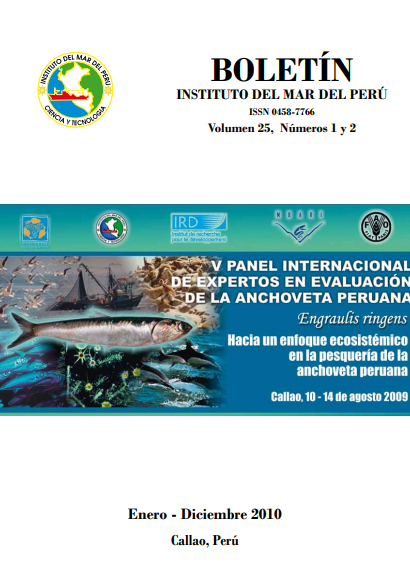
Biology of Peruvian anchovy, Engraulis ringens Jenyns
Keywords:
Peruvian anchovy, Humboldt Current Ecosystem, El Niño eventsAbstract
The Peruvian anchovy (anchoveta) is the key species of the trophic chain of the Peruvian upwelling system characterized by levels of productivity higher than any other marine ecosystem. The main biological aspects of anchoveta were analyzed during periods of high resource abundance and of declining population levels. The anchovy has a fast recovery after warm events because the population responds to the normalization of environmental conditions, also reducing its mortality.
Downloads
Metrics
References
Ayón P, Purca S, Guevara-Carrasco R. 2004. Zooplankton volume trends off Peru between 1964 and 2001. ICES Journal of Marine Science. 61: 478-484.
Ayón P, Swartzman G. 2008. Changes in the long–term distribution of zooplankton in the Humboldt Current Ecosystem off Peru, 1961-2005, and its relationship to regime shifts and environmental factors. Fisheries Oceanography 17(6): 421-431.
Agüero M, Claverí M. 2007. Capacidad de pesca y manejo pesquero en América: una síntesis de casos. FAO Documento Técnico de Pesca. N° 461:61-71.
Bakun A, Weeks S. 2008. The marine ecosystem off Peru: What are the secrets of its fishery productivity and what might its future hold?. Progress in Oceanography 79: 290 – 299.
Carrasco S, Lozano O. 1989. Seasonal and long-term variations of zooplancton volumen in the Peruvian sea, 1964-1987. In: Pauly D, Muck P, Mendo J, and Tsukayama I. (Eds.). The Peruvian upwelling ecosystem: dynamics and interactions. ICLARM. Instituto del Mar del Perú (IMARPE); Deutsche Gesellschaft fur Technische Zusammenarbeit (GTZ), GMBH, Eschborn, Federal Republic of Germany; and International Center for Living Aquatic Resources Management (ICLARM), Manila, Philippines: 82-85.
Chávez F, Ñiquen M, Csirke J, Bertrand A, Wosnitza C, Guevara-Carrasco R. 2009. Fifth International Panel on the Anchoveta: towards an ecosystem approach to fisheries. GLOBEC International Newsletter October 2009. P 14 – 15.
Chirichigno N, Vélez J. 1998. Clave para identificar los peces marinos del Perú (2da Edición). Pub. Esp. Inst. Mar Perú. 500 pp.
Dickie LM, Valdivia JE. 1981. Informe sumario, investigación cooperativa de la anchoveta y su ecosistema-ICANE Entre Perú y Canadá. Boletín IMARPE, Vol. Extraordinario ISSN-Q 378-7669, I-XXIII.
Espinoza P, Bertrand A. 2008. Revisiting Peruvian anchovy (Engraulis ringens) trophodynamics provides a new vision of the Humboldt Current system. Progress in Oceanography 79: 215-227.
Espinoza P, Bertrand A, Van Der Lingen CD, Garrido S, Rojas de Mendiola B. 2009. Diet of sardine (Sardinops sagax) in the northern Humboldt Current system and comparison with the diets of clupeoids in this and other eastern boundary upwelling systems. Progress in Oceanography 83, 242-250.
Fréon P, Misund OA. 1999. Dynamics of pelagic fish distribution and behaviour effects on fisheries and stock assessment. Blackwell Science, Oxford, 348 pp.
James AG. 1987. Feeding ecology, diet and field-based studies on feeding selectivity of the Cape anchovy Engraulis capensis Gilchrist. En Payne AIL, Gulland JA, Brink KH (Eds.) The Benguela and comparable ecosystems. South African Journal of marine Science 5: 673-692.
James AG, Findlay KP. 1989. Effect of particle size and concentration on feeding behaviour, selectivity and rates of food ingestion by Cape anchovy Engraulis capensis. Marine Ecology Progress Series 50: 275-294.
Jordán R. 1971. Distribution of anchoveta (Engraulis ringens J.) in relation to the environment. Inv. Pesq. 35(1): 113-126.
Mendo J. 1991. Stock identification of Peruvian anchoveta (Engraulis ringens): morphometric, tagging/recapture, electrophoretic and ecological studies. Vorgelegt dem Fachbereich 2 (Biologie) der Universitaet Bremen als Dissertation zur Erlangung des Grades eines Doktors der Naturwissenschaften (Dr. rer. nat): 144 pp.
Nixon S, Thomas A. 2001. On the size of the Peru upwelling ecosystem. Deep-Sea Research I 48: 2521 – 2528.
Ñiquen M, Bouchon M. 2004. Impact of El Niño events on pelagic fisheries in Peruvian waters. Journal Deep Sea Research II N°51 (2004): 563-574.
Palomares M, Muck P, Mendo J, Chuman E, Gomez O, Pauly D. 1987. Growth of the Peruvian Anchoveta (Engraulis ringens), 1953 to 1982. The Peruvian Anchoveta and Its Upwelling Ecosystem: Three Decades of Change. Edited by D. Pauly and I. Tsukayama. 351 pp.
Rojas de Mendiola B. 1971. Some observations on the feeding of the Peruvian anchoveta Engraulis ringens J. in two regions of the Peruvian coast. In Costlow, J.D. (Ed.) Fertility of the Sea. New York, Gordon and Breach Science Publisher 2: 417-440.
Pauly D, Tsukayama I. 1987. On the implementation of management-oriented fishery research: the case of the Peruvian anchoveta. In: Pauly D, and Tsukayama I. (Eds.). The Peruvian anchoveta and its upwelling ecosystem: three decades of changes. ICLARM. Instituto del Mar del Perú (IMARPE); Deutsche Gesellschaft fur Technische Zusammenarbeit (GTZ), GmbH, Eschbom, Federal Republic of Germany; and International Center for Living Aquatic Resources Management (ICLARM), Manila, Philippines:1-13.
Santander H, Zuzunaga J. 1984. Cambios en algunos componentes del ecosistema marino frente al Perú durante el fenómeno El Niño 1982-83. Rev. Com. Perm. Pacífico Sur (15): 311-331.
Schaefer M. 1967. Dinámica de la pesquería de anchoveta (Engraulis ringens) en el Perú. Bol. Inst. Mar Perú. Callao. 1(5): 191-303.
Sparre P, Venema S. 1992. Introduction to tropical fish stock assessment. Part I – Manual. FAO Fisheries Technical Paper Nº 306. 1, Rev. 1. Rome, FAO. 1992, 376 pp.
Downloads
Published
How to Cite
Issue
Section
License
Copyright (c) 2010 Instituto del Mar del Perú

This work is licensed under a Creative Commons Attribution 4.0 International License.
© Bol Inst Mar Perú. La revista retiene los derechos patrimoniales de los autores con la finalidad de garantizar el acceso abierto de los manuscritos.
Todos los manuscritos publicados en la revista se distribuyen bajo la licencia “Creative Commons Atribución - NoComercial - CompartirIgual 4.0 Internacional” (CC BY-NC-SA 4.0). Implica que autores y lectores pueden de forma gratuita descargar, almacenar, copiar, redistribuir, remezclar, transformar o generar obras derivadas a partir del manuscrito, siempre y cuando mencionen la fuente primaria de publicación y la autoría del manuscrito, así como que se realice sin fines comerciales y se distribuya bajo la misma licencia que el original. Puede consultar desde aquí la versión informativa y el texto legal de la licencia.


