Distribution and biomass of the pelagic, neritic, and oceanic resources in the Peruvian marine ecosystem obtained through hydroaoustic cruises (2019)
Keywords:
pelagic resources, distribution, biomassAbstract
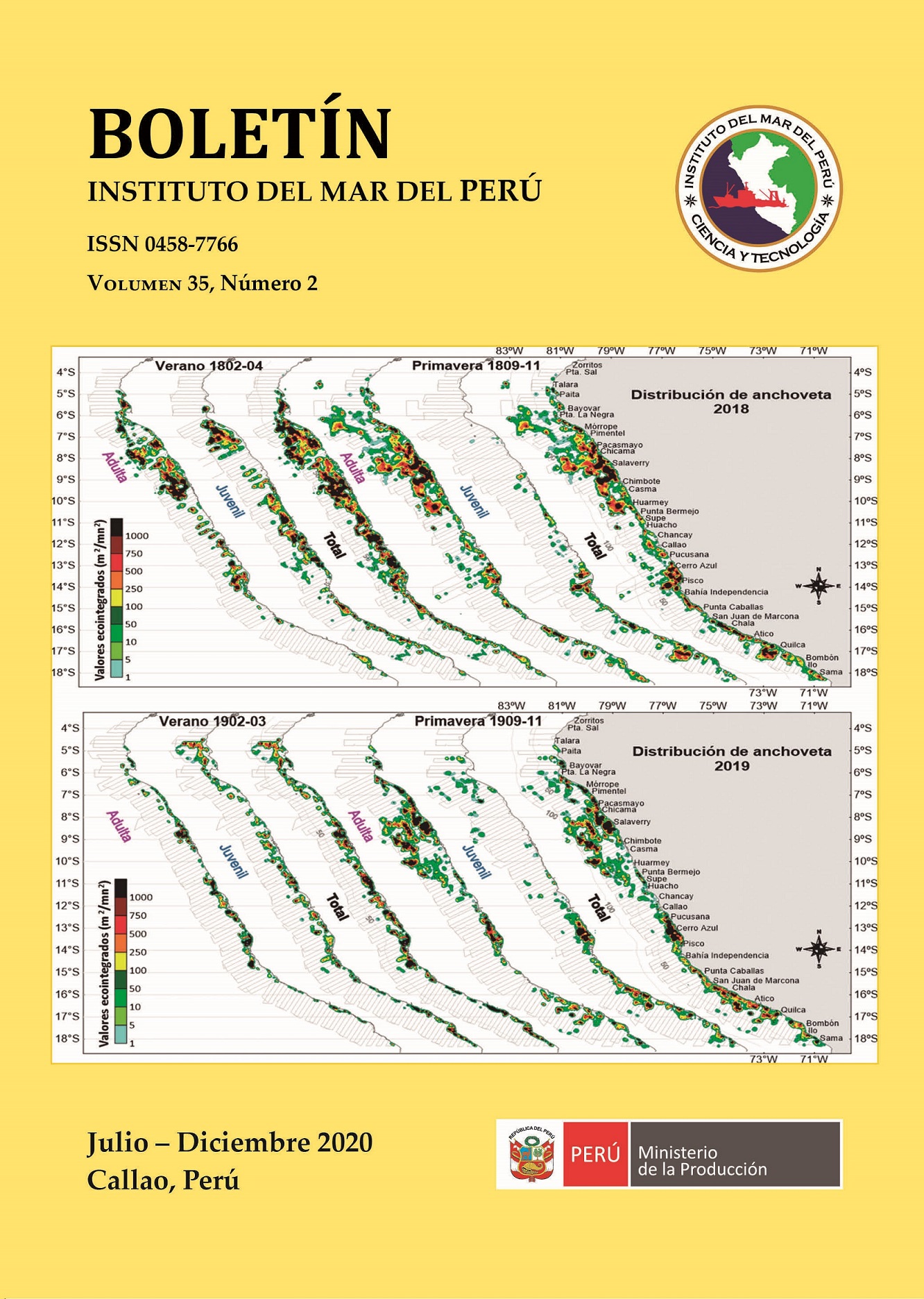
In 2019, we carried out two hydroacoustic cruises, one in the summer (Cr. 1902-03) between February 12 and March 27 and the other one in the spring (Cr. 1909-11) between September 29 and November 15. These cruises were conducted by IMARPE vessels and those of the National Fishing Society to increase biological and acoustic sampling. We analyzed the results of both cruises to know the distribution and biomass of the pelagic species such as anchoveta, munida lobster, samasa, catfish and oceanic species such as jack mackerel, chub mackerel, jumbo flying squid, and vinciguerria lightfish in the Peruvian marine ecosystem. We interpolated data by kriging and the biomass by stratification in isoparalittoral areas to obtain the distribution. Anchoveta and munida lobster were more abundant in the coastal area while jumbo flying squid and vinciguerria lightfish were more abundant in the oceanic zone. The anchoveta was recorded near the coast up to 72 nm with biomass of 8.82 million tons in summer and offshore up to 115 nm with biomass of 8.38 million tons in spring. The munida lobster was distributed between Chimbote-Sama in summer and between Bayovar-Sama in spring. Jack mackerel and chub mackerel had higher biomass and presence in spring (797,262 and 791,459 tons, respectively). The jumbo flying squid and vinciguerria lightfish had similar characteristics, with larger distribution areas and biomass (759,274 and 1,270,707 tons, respectively). Oceanographic conditions were normal or neutral for almost the whole year. In conclusion, the anchoveta biomass continued to be abundant when compared to other pelagic species, both neritic and oceanic, and the presence of juveniles in 2019 determined that we should be cautious in its management.
Downloads
Metrics
References
Bertrand A, Gerlotto F, Bertrand S, Gutiérrez M, Alza L, Chipollini A, Díaz E, Espinoza P, Ledesma L, Quesquén R, Peraltilla S, Chavez F. 2008. Schooling behaviour and environmental forcing in relation to anchoveta distribution: an analysis across multiple spatial scales. Progress in Oceanography. 79: 264-277.
Castillo P R, Peraltilla S, Aliaga A, Flores M, Ballon M, Calderón J, Gutiérrez M. 2011. Protocolo técnico para la evaluación acústica de las áreas de distribución y abundancia de recursos pelágicos en el mar peruano. Versión 2009. Inf Inst Mar Perú. 36(1-2): 7–28.
Castillo R, Dalla Rosa L, García Díaz W, et al. 2018. Anchovy distribution off Peru in relation to abiotic parameters: A 32-year time series from 1985 to 2017. Fish Oceanogr. 00: 1–13. https://doi.org/10.1111/fog.12419
Chavez F, Bertrand A, Guevara-Carrasco R, Soler P, Csirke J. 2008. The northern Humboldt Current System: brief history, present status and a view towards the future. Prog. Oceanogr. 79: 95–105.
Demer DA, Berger L, Bernasconi M, Bethke E, Boswell K, Chu D, Domokos R, et al. 2015. Calibration of acoustic instruments. ICES Cooperative Research Report. (326): 133. DOI: http://dx.doi.org/10.25607/OBP-185
Gutiérrez M, Gerlotto F. 2016. Dinámica de la interacción espacial entre agregaciones de anchoveta (Engraulis ringens) y la pequeña langosta múnida (Pleuroncodes monodon) en el curso de un ciclo nictemeral. Inf Inst Mar Perú. 43(3): 264-274.
Gutiérrez M, Castillo R, Segura M, Peraltilla S, Flores M. 2012.Trends in spatio-temporal distribution of Peruvian anchovy and other small pelagic fish biomass from 1966-2009.Lat Am J Aquat Res. 2012;40: 633-48.
Gutiérrez M. 1999a. Mediciones In situ de TS a finales de la primavera 1998. Crucero BIC José Olaya Balandra 9811-12. Inf. Inst. Mar Perú 146: 7-10.
Gutiérrez M, MacLennan D. 1998. Resultados preliminares de las mediciones de fuerza de blanco in situ de las principales especies pelágicas. Inf. Inst. Mar Perú 135: 16-19.
Gutiérrez M. 1999. Mediciones In situ de TS a finales del verano 1999. Crucero BIC José Olaya Balandra 9902-03. Inf. Inst. Mar Perú 147: 7-10.
Hastie T, Tibshirani R. 1990. Generalized Additive Models. Chapman and Hall, London. 335 pp.
Heck C. 2015. Hacia un manejo ecosistémico de la pesquería peruana de anchoveta. Sociedad Peruana de Derecho Ambiental (SPDA). Perú. 45 pp.
IMARPE. 2019a. Situación del stock norte-centro de la anchoveta peruana (Engraulis ringens) al 05 de noviembre de 2019 y perspectivas de explotación para la segunda temporada de pesca 2019. Informe interno. IMARPE. 25 pp.
IMARPE. 2019b. Elaboración de la tabla de decisión para la determinación del límite máximo de captura total permisible por temporada de pesca en la pesquería del stock norte-centro de la anchoveta peruana. IMP-DGIRP/AFDPERP. Informe interno IMARPE. 39 pp.
IMARPE. 2019c. Crucero de Evaluación Hidroacústica de Recursos Pelágicos 1902-03. Informe Ejecutivo. IMARPE. 64 pp.
IMARPE. 2019d. Informe del Crucero de Evaluación Hidroacústica de Recursos Pelágicos 1909-11”. Informe Ejecutivo. IMARPE. 66 pp.
IMARPE. 2019e. Informe del Crucero 1908-09 de Evaluación de Biomasa desovante de la anchoveta en el invierno del 2019. Informe Ejecutivo. IMARPE. Lima. Perú.
IMARPE. 2020. Condiciones oceanográficas y biológico-pesqueras, diciembre 2019. Actividad 4: Generación de Información y Monitoreo del Fenómeno El Niño. Programa Presupuestal por Resultados N°068. IMARPE. 68 pp.
INEI. 2019. Informe técnico Comportamiento de la Economía Peruana en el Cuarto Trimestre de 2018. Producto Bruto Interno Trimestral. Instituto Nacional de Estadística e Informática. 56 pp.
Korneliussen R J, Diner N, Ona E, Fernandes P G. 2004. Recommendations for the collection of multi-frequency acoustic data. ICES CM2004/R. 36: 15.
Korneliussen R J, Ona E. 2003. Synthetic echograms generated from the relative frequency response. – ICES Journal of Marine Science. 60: 636–640.
MacLennan D N, Gutiérrez M, Castillo R, Ganoza F, Escudero L, Gonzales A, Chalén X, Aliaga A. 1998. Fuerza de Blanco de anchoveta (Engraulis ringens) utilizando frecuencias de 38 y 120 kHz. Inf. Inst. Mar Perú 133: 15-25.
Mamani D. 2020. Informe técnico interno sobre caída a tierra de energía eléctrica los BIC José Olaya, Flores Portugal y Humboldt. DGIHSA-AFH. IMARPE. 6 pp.
Morón O. 2000. Características del ambiente marino frente a la costa peruana. Bol Inst Mar Perú .19(1-2): 179–204.
Murase H, Nagashima H, Yonezaki S, Matsukura R, Kitakado T. 2009. Application of a generalized additive model (GAM) to reveal relationships between environmental factors and distributions of pelagic fish and krill: a case study in Sendai Bay, Japan. ICES Journal of Marine Science. 66: 1417–1424.
Simmonds J, MacLennan D. 2005. Fisheries Acoustics. Theory and Practice. Second edition published by Blackwell Science. 436 pp.
Downloads
Published
How to Cite
Issue
Section
License

This work is licensed under a Creative Commons Attribution 4.0 International License.
© Bol Inst Mar Perú. La revista retiene los derechos patrimoniales de los autores con la finalidad de garantizar el acceso abierto de los manuscritos.
Todos los manuscritos publicados en la revista se distribuyen bajo la licencia “Creative Commons Atribución - NoComercial - CompartirIgual 4.0 Internacional” (CC BY-NC-SA 4.0). Implica que autores y lectores pueden de forma gratuita descargar, almacenar, copiar, redistribuir, remezclar, transformar o generar obras derivadas a partir del manuscrito, siempre y cuando mencionen la fuente primaria de publicación y la autoría del manuscrito, así como que se realice sin fines comerciales y se distribuya bajo la misma licencia que el original. Puede consultar desde aquí la versión informativa y el texto legal de la licencia.


