Bycatch of jumbo flying squid (Dosidicus gigas) in the Peruvian purse-seine fishery
Keywords:
Dosidicus gigas, Jumbo flying squid, Peruvian purse-seine fishery, bycatchAbstract
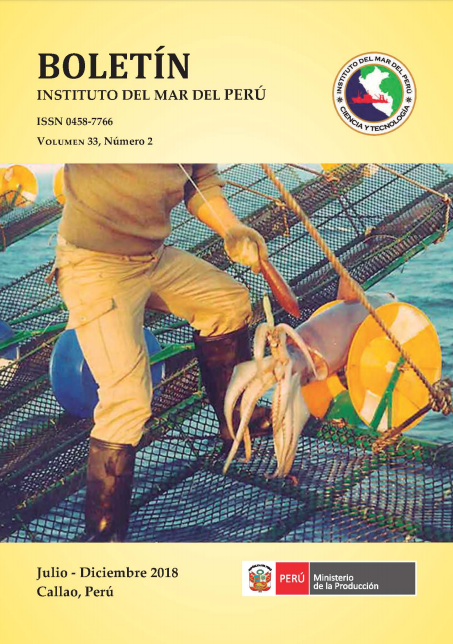
We analyzed the bycatch of jumbo flying squid (Dosidicus gigas) in the Peruvian purse-seine fishery between 2000 and 2015. The area of study corresponded to the space between the northern and southern extremes of the 200 mile Peruvian jurisdictional sea. The highest bycatch in the north-central zone (Northern tip - 16°S) is noteworthy, being significantly lower south of 16°S. The analysis of the bycatch during the first fishing season for anchoveta shows that the greatest incidence of jumbo flying squid was recorded between April and June (autumn), which together represented 18.67% of the period coinciding with the greatest coverage (10 to 100 nm) and therefore the greatest deployment of fishing effort. During the fishery for jack and chub mackerel, the highest incidence was recorded between January and May (summer-autumn), coinciding with the highest availability of jack mackerel, with records up to 230 miles from the coast. The wide distribution of D. gigas in Peru from the coastal zone to beyond 200 nm, makes it present as a fauna accompanying the capture of pelagic resources in the different fisheries, mainly in Northern Peru.
Downloads
Metrics
References
Baker A de C. 1960. Observations of squid at the surface in the NE Atlantic. Deep-Sea Res. 6: 206-210.
Bouchon M, Ñiquen M, Arias-Schreiber M, Bello R. 1997. Manual de Operaciones del Proyecto Bitácoras de Pesca. Inf Prog Inst Mar Perú. 74: 44 pp.
Bouchon M, Cahuín S, Díaz E, Ñiquen M. 2000. Captura y esfuerzo pesquero de la pesquería de anchoveta peruana (Engraulis ringens). Bol Inst Mar Perú. 19 (1 y 2): 109 – 116.
Bouchon M, Ñiquen M, Mori J, Echeverría A, Cahuín S. 2001. Manual de muestreo de la pesquería pelágica. Inf Prog Inst Mar Perú. 157: 14 pp.
Bouchon M, Peña C, Limache J, Diaz E. 2013. On board fisheries observer program: “logbook”: towards the ecosystem-based approach in Peru. Proceedings of the 7th International Fisheries Observer and Monitoring Conference. Instituto de Fomento Pesquero (IFOP), Chile. 46-49.
Clarke M R. 1966. A review of the systematics and ecology of oceanic squids. Adv. Mar. Biol. 4: 91-300.
Chirinos O, Adachi L, De La Torre C, Ortega A, Ramírez P. 2009. Industrialización y exportación de derivados de la pota. Universidad ESAN (Serie Gerencia Global; 15). 134 p.
FAO. 1997. Comité de Pesca. 22º período de sesiones. Las Capturas Incidentales y los Descartes en la Pesca. Roma, Italia, 17-20 de marzo de 1997. COFI/97/Inf.7. Extraído de: http://www.fao.org/docrep/meeting/w3862s.htm
Flores O, Segura M, Aliaga A. 2016. Biomasa y distribución del calamar gigante (Dosidicus gigas) en el mar peruano aplicando el método hidroacústico: 1999 - verano 2015. Inf Inst Mar Perú. 43 (1): 5-10.
Joo R, Grados D, Bouchon M, Díaz E. 2016. Tamaño óptimo de muestra del programa de observadores a bordo de la flota dirigida a la explotación de la anchoveta peruana (Engraulis ringens). Revista peruana de biología. 23(2): 169 - 182. doi: http://dx.doi.org/10.15381/rpb.v23i2.12429
Lorrain A, Argüelles J, Alegre A, Bertrand A, Munaron J-M, Richard P, Cherel Y. 2011. Sequential isotopic signature along gladius highlights contrasted individual foraging strategies of jumbo squid (Dosidicus gigas). PLoS ONE 6(7): e22194. https://doi.org/10.1371/journal.pone.0022194
Mariátegui L, Taipe A. 1996. Distribución y abundancia relativa del calamar gigante (Dosidicus gigas) en el Perú. Inf Prog Inst Mar Perú. 34: 3-27.
Mariátegui L. 2004. Distribución, concentración y abundancia relativa del calamar gigante Dosidicus gigas asociada a la temperatura superficial del mar en el Perú, durante 1991-1996. Tesis para optar grado de Maestro en Ciencias del Mar. Universidad Nac. Federico Villarreal, Lima-Perú. 84 pp.
Mariátegui L. 2009. Pesquería sostenible del calamar gigante Dosidicus gigas (d ́Orbigny, 1835), en el mar peruano. Tesis para optar grado de Doctor en Medio Ambiente y Desarrollo Sostenible. Universidad Nac. Federico Villarreal, Lima-Perú. 175 pp.
Mariátegui L, Pizarro L, Blascovic V, Goicochea C, Vásquez L, Marquina R, Crispín A. 2011. El calamar gigante en el mar peruano. Crucero B/P Hakurei Maru N° 8. Primavera 2010 y verano 2011. Inf Inst Mar Perú. 38 (4): 395 – 413.
Nesis K N. 1983. Dosidicus gigas. Cephalopod life cycles, Volume I.P.R. Boyle. Academic Press. New York. 215-231.
Nigmatullin C M, Nesis K N, Arkhipkin A I. 2001. A review of the biology of the jumbo squid Dosidicus gigas (Cephalopoda: Ommastrephidae). Fish. Res. 54: 9–19.
Roper C F E, Young R E. 1975. Vertical distribution of pelagic cephalopods Smithson. Contrib. 2001(209): 51 p.
Taipe A, Yamashiro C, Mariátegui L, Rojas P, Roque C. 2001. Distribution and concentrations of jumbo flying squid (Dosidicus gigas) off the Peruvian coast between 1991 and 1999. Fish Res. 54: 21-32.
Vaske T. 2011. Are deep sea cephalopods really common preys for oceanic seabirds? Biota Neotrop. 11: 177-180.
Villarroel J, Vega M, Acuña E. 2001. Cefalópodos recolectados en la pesquería de crustáceos de la zona norte y centro-sur de Chile. Rev. Biología Marina y Oceanografía. 36(1): 83 – 97.
Yamashiro C, Mariátegui L, Taipe A. 1997. Cambios en la distribución y concentración del calamar gigante (Dosidicus gigas) frente a la costa peruana durante 1991-1995. Inf Progr Inst Mar Perú. (52): 3 – 40.
Yamashiro C, Mariátegui L, Rubio J, Arguelles J, Tafur R, Taipe A, Rabí M. 1998. Jumbo flying squid fishery in Peru. 119-125 pp. In Okutani, T. (Ed.), Contributed papers to International Symposium on Large Pelagic Squids, Tokyo. July 18-19, 1996. Jamarc. 269 pp.
Yatsu A, Tafur R, Maravi C. 1999. Embryos and Rhynchoteuthion paralarvae of jumbo flying squid Dosidicus gigas (Cephalopoda) obtained through artificial fertilization from Peruvian waters. Fish. Sci. 65: 904–908.
Downloads
Published
How to Cite
Issue
Section
License
Copyright (c) 2018 Instituto del Mar del Perú

This work is licensed under a Creative Commons Attribution 4.0 International License.
© Bol Inst Mar Perú. La revista retiene los derechos patrimoniales de los autores con la finalidad de garantizar el acceso abierto de los manuscritos.
Todos los manuscritos publicados en la revista se distribuyen bajo la licencia “Creative Commons Atribución - NoComercial - CompartirIgual 4.0 Internacional” (CC BY-NC-SA 4.0). Implica que autores y lectores pueden de forma gratuita descargar, almacenar, copiar, redistribuir, remezclar, transformar o generar obras derivadas a partir del manuscrito, siempre y cuando mencionen la fuente primaria de publicación y la autoría del manuscrito, así como que se realice sin fines comerciales y se distribuya bajo la misma licencia que el original. Puede consultar desde aquí la versión informativa y el texto legal de la licencia.


