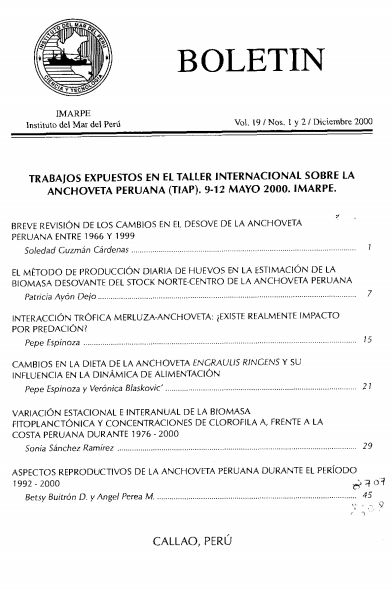
Changes in diet of Peruvian anchoveta Engraulis ringens and its influence on feeding dynamics
Keywords:
Peruvian anchovy, Engraulis ringens, diet, feeding, El Niño, Peruvian seaAbstract
On the basis of 6.606 stomachs of Peruvian anchoveta analised, during 1996-1999, the number of hours used during the ingestion period has been related to the daily feeding ration and diet quality. Samples were collected during Hydroacustic Evaluation Cruises carried out by IMARPE. It has been found that the ingestion period started earlier during EI Niño event. Total of ingestion hours increased and the daily feeding ration decreased. Before EI Niño event, in the northern-central zone, the anchovy fed mainly on diatoms, and ate copepods during it; in the southern area the inverse fact was observed. At the end and after EI Niño, in both areas, the copepods predominated in the diet. When EI Niño finished, the anchovy diet changed as its size increased. Along the littoral, individuals <10 cm fed on copepods and had a nocturnal feeding rhythm, from sunset to sunrise of the next day. Individuals >10 cm fed on copepods in northern-central area and on diatoms in southern area, showing a diurnal rhythm. Changes in the diet during this period confirm the opportunistic character of anchovy, varying its strategy and feeding dynamics, when environment changes occur.
Downloads
Metrics
References
ALAMO, A., I. NAVARRO, P. ESPINOZA y P. ZUBIATE. 1996. Relaciones tróficas, espectro alimentario y ración de alimentación de las principales especies pelágicas en el verano 1996. Inf. Inst. Mar Perú 122:36-46.
ALAMO, A., P. ESPINOZA, P. ZUBIATE y I. NAVARRO. 1997. Comportamiento alimentario de los principales recursos pelágicos peruanos en verano y comienzos de otoño 1997. Inf. Inst. Mar Perú 127:82-89.
ALAMO, A. y P. ESPINOZA. 1998. Variaciones alimentarias en Engraulis ringens y otros recursos pelágicos durante invierno-primavera 1997. lnf. Inst. Mar Perú 130:45-52.
BLASKOVIC', V., P. ESPINOZA, F. TORRIANI e I. NAVARRO. 1999. Hábitos alimentarios de la anchoveta frente al litoral peruano durante la primavera 1998. Crucero BIC José Olaya Balandra 9811-12. Inf. lnst. Mar Perú 146:77-84.
CRAWFORD, R. J. M. 1987. Food and population variability in five regions supporting large stocks of anchovy, sardine and horse mackerel. En: PAYNE, A. I. L., GULLAND, J. A. ANDK. H. BRINK (eds.) The Benguela and Comparable Ecosystems. S. Afr. J. mar. Sci. 5:735-757.
ESPINOZA, P, I. NAVARRO y F. TORRIANI. 1998a. Variaciones en el espectro alimentario de los principales recursos pelágicos durante otoño 1998. Crucero BIC Humboldt 9803-05 de Tumbes a Tacna. Inf. lnst. Mar Perú 135:134-142.
ESPINOZA, P., V. BLASKOVIC e I. NAVARRO. 1998b. Comportamiento alimentario de Engraulis ringens, a finales del invierno 1998. Crucero de Evaluación Hidroacústica de Recursos Pelágicos 9808-09. Inf. lnst. Mar Perú 141:67-71.
JAMES, A. G. 1987. Feeding ecology, diet and fieldbased studies on feeding selectivity of the Cape anchovy Engraulis capensis Gilchrist. En: PAYNE, A. I. L., GULLAND, J. A. y K. H. BRINK (eds.) The Benguela and Comparable Ecosystems. S. Afr. J. mar. Sci. 5: 673-692.
LEONG, R. J. H. y O'CONELL, C. P. 1969. A laboratory study of particulate and filter feeding of the northern anchovy Engraulis mordax. J. Fish. Res. Bd. Can. 26: 557-582.
MORON, O., N. DOMINGUEZ y P. CHAPILLIQUEN. 1998. Características oceanográficas durante el crucero pelágico BIC Humboldt y BIC José Olaya Balandra 9808-09 de Paita a Los Palos (Tacna). Inf. Inst. Mar Perú 141:96-113.
ÑIQUEN, M., A. ECHEVARRIA, M. BOUCHON, J. QUIÑONEZ, J. VALDEZ y S. CAHUIN. 1998. Cambios biológicos observados en los principales recursos pelágicos durante otoño de 1998 en el mar peruano. Crucero BIC José Olaya Balandra 9805-06 de Tacna a Máncora. Inf. Inst. Mar Perú 137:43-56.
PAULY, D., A. JARRE, S. LUNA, V. SAMBILAY JR., B. ROJASDE MENDIOLA Y A .. ALAMO. 1989. On the quantity and types of food ingested by Peruvian anchoveta, 1953-1982. En: D. PAULY, P. MUCK, J. MENDO E I. TSUKAYAMA (eds.). The Peruvian upwelling ecosystem: dynamics and interactions. ICLARM Conference Proceedings 18:109-124.
PITCHER, T. J., A. E. MAGURRAN y J. L. EDWARDS. 1985. Schooling mackerel and herring choose neighbours of similar size. Mar. Biol. 86:319-322.
RICHARDSON, A. J., H. M. VERHEYE, J. G. FIELD, S. M. PAYNE y E., WRIGHT. 1997. Assessment of the food available to Cape anchovy during their spawning season. S. Afr. J. mar. Sci. 18: 113-117.
ROJAS DE MENDIOLA, B., N. OCHOA, R. CALIENES y O. GOMEZ. 1969. Contenido estomacal de anchoveta en cuatro áreas de la Costa Peruana. Inf. lnst. Mar Perú 27. 30 pp.
ROJAS DE MENDIOLA, B. 1978. El alimento de la anchoveta Engraulis ringens J. en un área de afloramiento (San Juan). lnf. lnst. Mar Perú 49. 15 pp.
SANCHEZ, G., A. ALAMO y H. FUENTES.1985. Alteraciones en la dieta alimentaria de algunos peces comerciales por efecto del fenómeno El Niño. En: W. ARNTZ, A. LANDA y J. TARAZONA (eds.) El Niño su impacto en la fauna marina. Vol. Extraord. Bol. lnst. Mar Peru:135-142.
TSUKAYAMA, I. 1965. El numero de branquispinas como carácter diferencial de subpoblaciones de anchoveta Engraulis ringens en la Costa del Perú. Tesis para optar la licenciatura en Biología (UNMSM), Lima, Perú. 25 pp.
TUDELA, S. e I. PALOMERA.1995. Diel feeding intensity and daily ration in the anchovy Engraulis encrasicolus in the northwest Mediterranean Sea during the spawning period. Mar. Ecol. Prog. Ser. 129:55-61.
VILLAVICENCIO, Z. y P. MUCK. 1983. La ración de mantenimiento, la densidad de mantenimiento de Engraulis ringens y Sardinops sagax sagax como una medida de su potencia ecol6gica. Bol. Inst. Mar Perú 7(4):73-107.
Downloads
Published
How to Cite
Issue
Section
License
Copyright (c) 2000 Instituto del Mar del Perú

This work is licensed under a Creative Commons Attribution 4.0 International License.
© Bol Inst Mar Perú. La revista retiene los derechos patrimoniales de los autores con la finalidad de garantizar el acceso abierto de los manuscritos.
Todos los manuscritos publicados en la revista se distribuyen bajo la licencia “Creative Commons Atribución - NoComercial - CompartirIgual 4.0 Internacional” (CC BY-NC-SA 4.0). Implica que autores y lectores pueden de forma gratuita descargar, almacenar, copiar, redistribuir, remezclar, transformar o generar obras derivadas a partir del manuscrito, siempre y cuando mencionen la fuente primaria de publicación y la autoría del manuscrito, así como que se realice sin fines comerciales y se distribuya bajo la misma licencia que el original. Puede consultar desde aquí la versión informativa y el texto legal de la licencia.


